
Why Pay More for Performance Parts? What You Get

Table of Contents
- Why Pay More for Performance Parts? The Short Answer
- What Drives the Price of Aftermarket Parts
- Quality Motorcycle Parts vs Knockoffs: What the Money Buys
- How to Identify Counterfeit Motorcycle Parts Before You Buy
- Real Power Gains: What Performance Parts Actually Deliver
- Motorcycle Parts Fitment Guide: Getting Compatibility Right
- Motorcycle Parts Warranty and Returns: What to Check First
- When a Cheaper Part Is Good Enough
- Frequently Asked Questions
Last Updated: October 16, 2026
Why Pay More for Performance Parts? The Short Answer
You pay more for performance parts because the extra money buys verified materials, real testing, and a warranty that holds up when something fails.
Performance parts are aftermarket components engineered to improve how a vehicle breathes, handles, stops, or holds together under load.
Here is the honest version: cheap parts are cheap for a reason, and that reason is rarely generosity.
What Drives the Price of Aftermarket Parts
Three forces set the price of any aftermarket part: what it is made from, how it is made, and how much testing sits behind it. A part that skips any of those steps costs less to produce, and it shows up later as poor fitment, short life, or outright failure.
Materials, Machining, and Manufacturing Costs
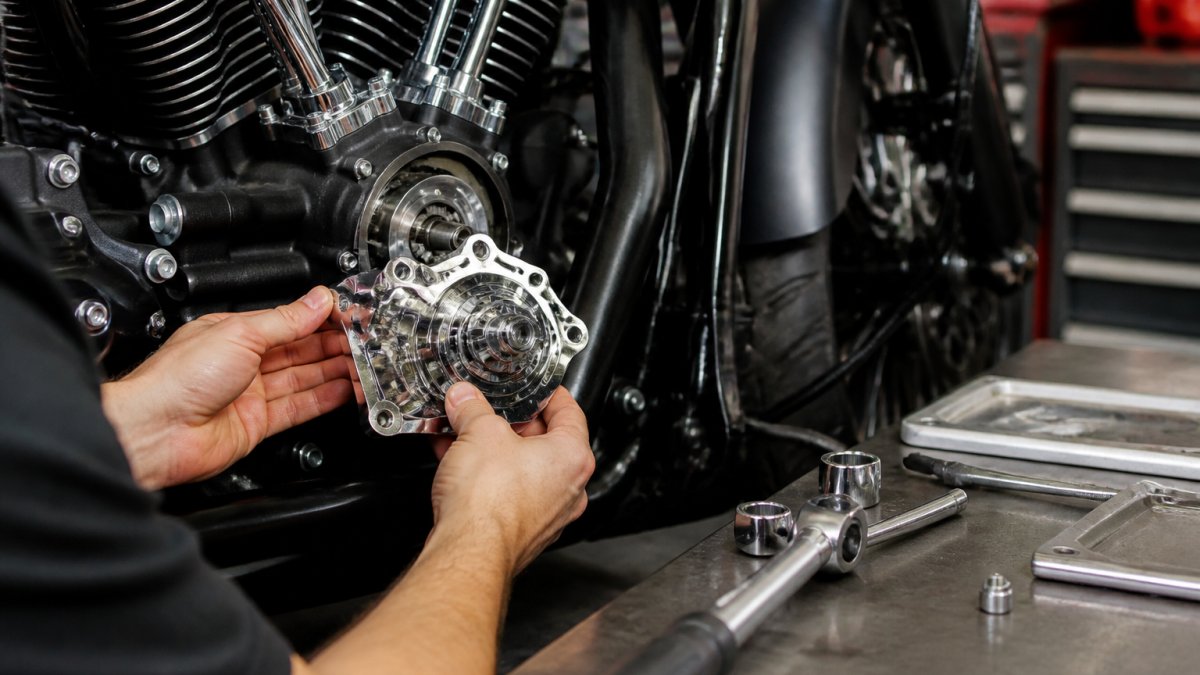
A billet 6061 aluminum component costs more than a cast one because the raw stock costs more and the machining takes longer. Precision work matters here. Consider the Fuelling Performance high volume oil pump for Harley M8 engines: every pump is bench tested, with the relief valve seated and sealed to a minimum of 30 psi and full pop-off at 55-60 psi.
Cheap parts skip that step. You get inconsistent tolerances and a part that may not survive its first hard ride.
Testing, Validation, and Supply and Demand
Validation is the invisible cost. A manufacturer that dyno-tests, heat-cycles, and road-validates a component carries that expense into the price. A knockoff operation copies the shape and skips the proof. Limited-run and discontinued parts also cost more because volume is low and tooling still has to be paid for.
Quality Motorcycle Parts vs Knockoffs: What the Money Buys
Quality motorcycle parts vs knockoffs comes down to traceability. A genuine part has a manufacturer, a part number, a tested spec, and a warranty. A knockoff has a similar shape and nothing behind it. But the deeper difference is not the purchase price. It is the total cost of ownership, what you actually spend from the day you buy the part to the day you stop using it.
The Purchase Price Is the Smallest Number
Most buyers compare sticker prices. That comparison is almost always wrong, because the sticker price is only the first of five costs:
- Purchase price. What you pay at checkout.
- Installation. Labor, specialty tools, and any fabrication the part requires. A part that does not fit cleanly can double its own cost in shop time.
- Supporting modifications. A high-flow intake may need a tune. A cam may need a matched oiling upgrade. A fork cartridge may need longer tubes. These are not optional, they are the cost of making the part work as designed.
- Maintenance. More power means more heat, and more heat means shorter service intervals on oil, filters, and consumables. That recurring cost belongs in the comparison.
- Failure and repair. A part that fails early can damage the components around it. A failed oil pump can take an engine with it. A failed brake pad can take the rider.
When you add those five lines, the cheap part is frequently the more expensive one.

A Concrete Example
Take brake pads as the test case. The Lyndall Racing Gold Plus brake pads we stock run $139.95 and deliver 20% more stopping power than stock pads, run cooler, and shed less dust than a sintered pad.
Now run the total cost. The budget pad saves roughly $90 at checkout. If it fades, warps a rotor, or forces an emergency stop that damages the bike, the repair bill starts in the hundreds and climbs.
Why Knockoffs Cannot Match the Total Cost
A knockoff operation copies the shape and skips the proof. That is not a shortcut, it is the entire business model. No bench testing, no heat cycling, no road validation, no warranty infrastructure, no part-number traceability. Every one of those skipped steps is a cost the legitimate manufacturer carries and the knockoff avoids. That is why the price gap exists, and it is why the knockoff cannot stand behind its product when something goes wrong.
How to Compare Two Parts Fairly
Before you choose between a premium part and a cheap one, write down five numbers: purchase price, installation cost, required supporting mods, expected maintenance over your ownership period, and the cost of a likely failure. Add them. The part with the lower total is the cheaper part, regardless of what the sticker said.
How to Identify Counterfeit Motorcycle Parts Before You Buy
Counterfeit motorcycle parts give themselves away through packaging, weight, and paperwork. Check these before money changes hands:
- Packaging quality: Blurry printing, misspelled brand names, and flimsy boxes are red flags.
- Part number verification: Cross-check the number against the manufacturer's own catalog.
- Weight and finish: A part that feels noticeably lighter or has rough casting marks is suspect.
Real Power Gains: What Performance Parts Actually Deliver
Real power gains come from improving airflow in and out of the engine, then supporting that flow with tuning and maintenance. A single bolt-on rarely transforms a bike. A matched system does.
Airflow, Exhaust Flow, and Horsepower
Airflow and exhaust flow are the two levers that move horsepower and torque. The S&S Cycle 55mm intake manifold we carry adds 3-5 hp and is built for big bore engines, because the stock plastic manifold starts restricting flow once you push past 124 cubic inches.
Notice the claim: 3-5 hp, stated plainly. That is what honest performance improvement looks like. A seller promising 20 hp from an intake alone is selling a story.
FUELING PERFORMANCE HP HIGH VOLUME OIL PUMP HARLEY DAVIDSON M8 →
Supporting Mods, Tuning, and Maintenance
A single part rarely delivers its full gain without support. Bolt on a high-flow intake and the engine needs a matching tune. Add a cam and the oiling system becomes the weak link.
Maintenance is part of the cost, not separate from it. More power means more heat, and more heat means shorter service intervals on oil and filters.
Motorcycle Parts Fitment Guide: Getting Compatibility Right
Fitment and compatibility decide whether a part works at all. Check year, model, engine platform, and any required companion parts before you order.
The Racing Bros Scepter 25 fork cartridge kit shows why this matters. It fits 2018-2025 Softails with 49mm forks, but excludes the FLSB, FXFB, FXDRS, and FXLRS models that run 43mm forks. It also requires longer fork tubes when fitted with the +2" option.
Motorcycle Parts Warranty and Returns: What to Check First
Warranty and returns terms tell you how much the seller trusts their own product. Read them before you buy, not after something breaks.
Ask three questions:
- What does the warranty cover? Defects in materials and workmanship are standard. Racing use and installation errors usually void coverage.
- How long does it run, and from what date? A warranty starting at purchase, not installation, can expire before you even ride.
- Who pays return shipping? A seller who covers it stands behind the part. One who does not is telling you something.
Keep your receipt and part number. Without them, most warranty claims go nowhere.
When a Cheaper Part Is Good Enough
A cheaper part is good enough when it is a low-stress component with no safety role and no performance claim tied to it. Cosmetic covers, non-load-bearing brackets, and general replacement hardware rarely justify premium pricing. But "cheap is fine here, premium is fine there" is not a decision framework. The real question is whether a specific part, at a specific price, earns its money for how you actually ride.
A Four-Question Test for Any Premium Part
Before you pay a premium, run the part through these four questions. If it fails two or more, the budget option is probably the smarter buy.
- What is the measured gain, and who measured it? A manufacturer who publishes a dyno chart, a flow bench number, or a bench-test spec is giving you something to verify. A seller who only promises "more power" is not. Ask for the test method, not just the result.
- What is the total cost to make it work? A high-flow intake that adds 3-5 hp may also require a tune, a matching exhaust, and a reflash. Add those to the purchase price before you compare it to a cheaper part. A $400 part that needs $600 of supporting work is a $1,000 decision.
- What happens if it fails? A failed cosmetic cover is an inconvenience. A failed brake pad, fork cartridge, or oil pump is a safety event. The higher the consequence of failure, the stronger the case for paying for validation.
- How long will you keep the vehicle? A premium part amortizes over years of use. If you are flipping the bike next season, a budget part that meets spec may be the rational choice.
Where Budget Parts Genuinely Win
Budget parts are not automatically bad. They win in specific, predictable situations:

- Low-stress, non-safety components. Cosmetic trim, covers, and non-load-bearing brackets rarely justify premium pricing because failure is cheap and non-dangerous.
- Short-ownership vehicles. If you are selling within a season, the premium part's durability advantage may never pay out.
- Stock-spec replacement. When you are replacing a worn part on a stock vehicle and have no performance goal, an OEM-equivalent part that meets the original specification is often the correct answer.
Where Premium Pays for Itself
Premium pays when the part is doing hard work under load. Brakes, suspension, oiling, and anything inside the engine are the categories where a cheap substitute costs more in the long run, not just in money, but in downtime and risk.
The honest rule: spend where failure hurts, save where it does not. Everything else is marketing.
| Part Type | Go Premium | Budget Is Fine |
|---|---|---|
| Brakes | Always | Never |
| Suspension | Always | Never |
| Engine internals | Always | Never |
| Cosmetic trim | Rarely | Usually |
| Non-load brackets | Rarely | Usually |
Frequently Asked Questions
Why are performance parts more expensive than stock replacement parts?
Higher-grade materials, tighter machining tolerances, and bench testing all add cost. A billet aluminum manifold or a bench-tested oil pump takes more machine time than a mass-produced plastic or cast factory unit. Lower production volumes also spread development costs across fewer units. The price gap usually reflects durability, fitment accuracy, and verified output rather than branding alone. On a big build, that difference often pays back through fewer repeat failures and less downtime.
How can you tell if an aftermarket motorcycle part is good quality?
Look for documented specs: material grade, measured tolerances, and test results. A seller who publishes bench-test data, such as a relief valve popping off within a stated pressure range, is showing you evidence. Check that the part number matches your exact model year and that the listing names the required supporting components. Ask whether the part is matched to other upgrades, since some high-flow engine parts only work correctly alongside a compatible camplate or intake.
Do performance parts improve power, handling, or reliability?
It depends on the part and the supporting build. An intake manifold listed as adding 3-5 hp on a big bore engine changes power, while a cartridge fork kit changes handling and feedback. Reliability gains usually come from parts that fix a known weak point, such as an oil pump that reduces wet sumping and blow by. Gains claimed without a supporting modification list are a warning sign. Match each part to the outcome you actually want.
Can cheap motorcycle parts damage your bike?
They can. A counterfeit or poorly machined part may fit loosely, wear faster, or fail under heat and load, and the damage can spread to surrounding components. Brake and engine internals carry the most risk because a failure there affects safety and the whole motor. The safer approach is to verify the seller, confirm the part number against your model, and check the warranty and return terms before ordering. A lower price is not a saving if the part takes the bike off the road.
Deciding what is worth the money is the hard part of any build. Our team at THE SPEED SHOP CANADA helps riders work through fitment, compatibility, and budget before a single part ships, and we back it with free shipping on orders over $200 plus flexible payment options like Shop Pay, RBC PayPlan, and Sezzle. Get started with THE SPEED SHOP CANADA and build it right the first time.
Quote of the Day
Style is more than what we wear or how we decorate our spaces — it’s the freedom to choose what reflects who we are. Every design, every detail, is crafted with intention: to inspire joy, to add meaning, and to transform the everyday into something extraordinary. Because when comfort meets elegance, life itself feels more beautiful.
Brand Description
At our core, we believe that style should feel effortless yet meaningful. Each collection is carefully designed with attention to detail, blending modern aesthetics with everyday comfort. From timeless silhouettes to refined textures, our pieces are crafted to inspire confidence and elevate the way you live and dress. More than fashion, it’s a lifestyle made for you.