
Table of Contents
- Why a Custom Exhaust System Changes Everything on a Hot Rod
- Hot Rod Exhaust Header Design: Mandrel Bends, Primary Length and Collector Sizing
- Stainless Steel vs Aluminized Steel for Custom Exhaust Systems
- Choosing Mufflers, X-Pipes and Tailpipe Tips for the Right Exhaust Note
- Exhaust System Noise Regulations and Street-Legal Compliance
- Custom Exhaust Fabrication Tools and Step-by-Step Build Planning
- What You'll Need
- Step 1: Measure and Plan the Routing [Time: 2 hours]
- Step 2: Cut and Fit the Sections [Time: 3-4 hours]
- Step 3: Install Hangers and Supports [Time: 2 hours]
- Step 4: Weld Out and Test [Time: 3 hours]
- Weight Reduction, Thermal Management and Heat Shielding
- Conclusion: Planning Your Custom Exhaust Build
- Frequently Asked Questions
Last Updated: October 4, 2026
Why a Custom Exhaust System Changes Everything on a Hot Rod
A custom exhaust system is the single most consequential bolt-on decision on a hot rod build, because it governs airflow, sound, and how the car behaves under load. The exhaust is where every combustion event you paid for either gets evacuated efficiently or fights itself on the way out.

Below, we break down header design, material choice, muffler selection, and the compliance questions most guides skip entirely.
Hot Rod Exhaust Header Design: Mandrel Bends, Primary Length and Collector Sizing
Header design determines how well your engine breathes, and the three levers that matter most are bend quality, primary tube length, and collector size. Get these wrong and no muffler will rescue the power curve.
Mandrel-Bent Tubing vs Crush Bends
Mandrel-bent tubing keeps a constant internal diameter through the bend. Crush-bending, the cheap alternative, pinches the pipe and creates a restriction exactly where exhaust gas velocity is highest. On a performance build, mandrel bends are not a luxury; they are the difference between a header that flows and one that chokes.
Tubing Diameter, Scavenging and Backpressure
Bigger is not better. A common mistake is oversizing primary tubes, which kills exhaust gas velocity and destroys scavenging, the pressure wave that pulls the next charge out of the cylinder. Backpressure is not the goal either; you want controlled velocity, not restriction. Match tubing diameter to displacement and intended rpm range, and the torque curve fills in where you actually drive.
Stainless Steel vs Aluminized Steel for Custom Exhaust Systems
Stainless steel wins on longevity, while aluminized steel wins on upfront cost, and the right answer depends on how the car is used. Aluminized steel resists corrosion reasonably well and costs less, which makes it a sensible choice for a fair-weather build. Stainless holds up to heat cycling, moisture, and road salt far better over the long term.

T-304 Stainless Steel and Thermal Coating Options
T-304 stainless steel is the standard for a serious build: it handles high exhaust gas temperatures without scaling and keeps its appearance. Thermal coating, whether ceramic coating or exhaust wrap, manages under-hood heat and protects nearby components. Ceramic coating applied inside and out reduces surface temperature and preserves the metal underneath.
| Material | Upfront Cost | Corrosion Resistance | Best For |
|---|---|---|---|
| Aluminized steel | Lower | Moderate | Fair-weather builds |
| T-304 stainless | Higher | High | Year-round, long-term |
| Coated mild steel | Moderate | Good | Budget builds with heat control |
Choosing Mufflers, X-Pipes and Tailpipe Tips for the Right Exhaust Note
Muffler and crossover selection shape the exhaust note more than any other component, and the goal is a sound you can live with on a long drive. The key is understanding how each piece manipulates sound waves, not just picking a brand.
Muffler Types and How They Shape Sound
A chambered muffler uses internal baffles to cancel sound waves through reflection and interference, producing a deeper, more controlled tone at the cost of some flow.
Muffler case size matters as much as type. A longer case with more internal volume absorbs more low-frequency energy, which reduces drone.
X-Pipes vs H-Pipes: Crossover Mechanics
Drone reduction is the part nobody warns you about. That low-frequency resonance at highway cruise comes from the system's natural frequency, and an X-pipe or H-pipe crossover smooths the exhaust pulses that cause it.
The placement of the crossover matters. Moving it closer to the headers tends to emphasize higher frequencies; moving it rearward emphasizes lower tones.
Tailpipe Tips as Tuning Tools
Tailpipe tips are the final tuning tool: diameter and length change both tone and appearance. A larger-diameter tip acts as a megaphone, amplifying higher frequencies and increasing volume. A longer tip extends the tuning length of the system, which can shift resonance points. A 3-inch turnout reads very differently from a slash-cut, both visually and acoustically.
Matching the System to Your Engine
Camshaft overlap, compression ratio, and firing order all influence the exhaust note before the exhaust system even enters the picture. A system that sounds perfect on a small-block may drone on a big-block with a radical cam. Plan the exhaust as part of the engine combination, not as a final accessory.

Exhaust System Noise Regulations and Street-Legal Compliance
Street-legal compliance is where most hot rod exhaust guides go silent, and it is the fastest way to turn a build into a trailer queen. The regulatory landscape is a patchwork of provincial vehicle safety standards, municipal noise bylaws, and federal emissions requirements, and the rules that apply to you depend on where the vehicle is registered and driven.
Provincial Noise and Equipment Standards
Each province sets its own vehicle equipment and noise standards through its highway traffic act and associated regulations. For example, Ontario's Highway Traffic Act outlines equipment requirements, and specific noise limits may be detailed in accompanying regulations.
Municipal bylaws add another layer. Many cities have their own noise ordinances that apply to stationary vehicles, and some enforce idle-noise limits in residential areas. A system that passes a provincial inspection may still draw a bylaw complaint.
Federal Emissions Requirements
The federal government regulates emissions through the Canadian Environmental Protection Act and associated vehicle emissions regulations. These rules prohibit removing, bypassing, or defeating emissions control equipment on vehicles that were originally equipped with it. For hot rods built from older chassis, the requirements depend on the model year and whether the vehicle qualifies for exemptions. Transport Canada provides comprehensive information on these regulations.
Planning for Compliance
The practical approach is to plan the build around the strictest rule you will encounter, then keep documentation for the parts you install. This means:
- Choosing a muffler that meets or exceeds the original equipment noise level
- Avoiding cutouts or bypass valves that can be opened on public roads
- Retaining any emissions equipment that was originally installed
The Unique Angle: Compliance as a Design Constraint
Most guides treat compliance as an afterthought. A better approach is to treat it as a design constraint from day one. A system designed to be quiet enough for street use can still flow well enough for performance if you prioritize velocity over volume, use a well-designed crossover to cancel drone, and select a muffler with enough internal volume to attenuate low frequencies.
Custom Exhaust Fabrication Tools and Step-by-Step Build Planning
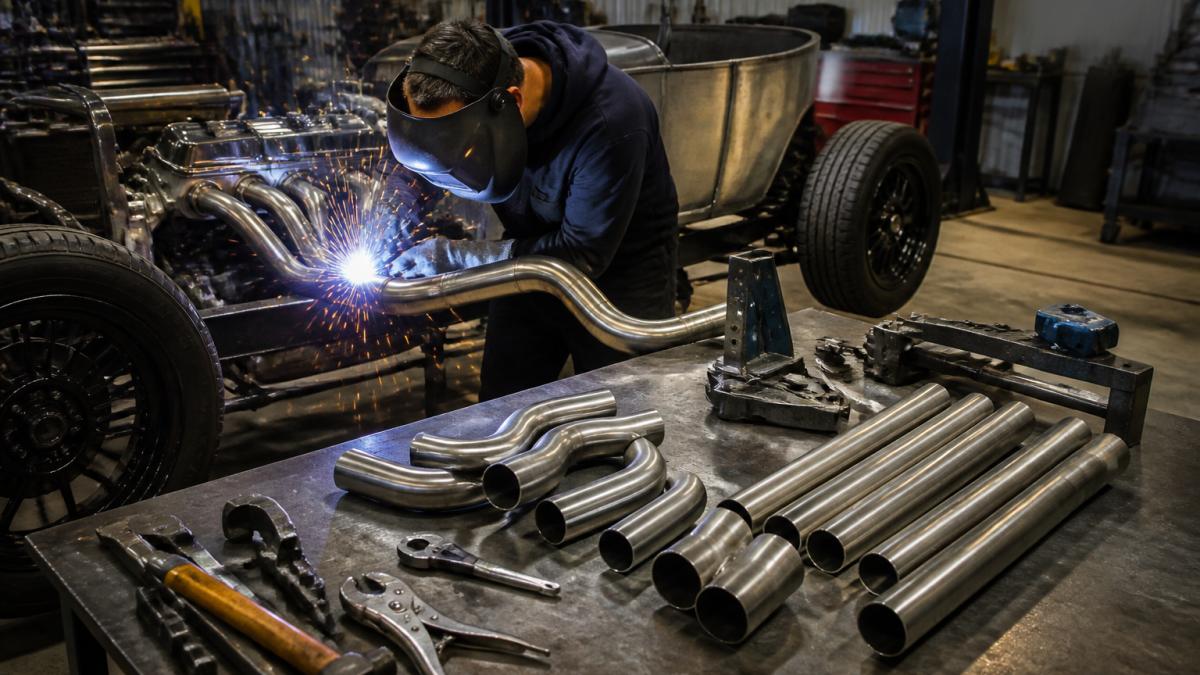
Fabrication planning separates a build that fits from one that fights you on every hanger. Before you cut anything, map the routing on the car itself, not on paper, because chassis clearance and exhaust hanger placement decide whether the system rattles or sits clean.
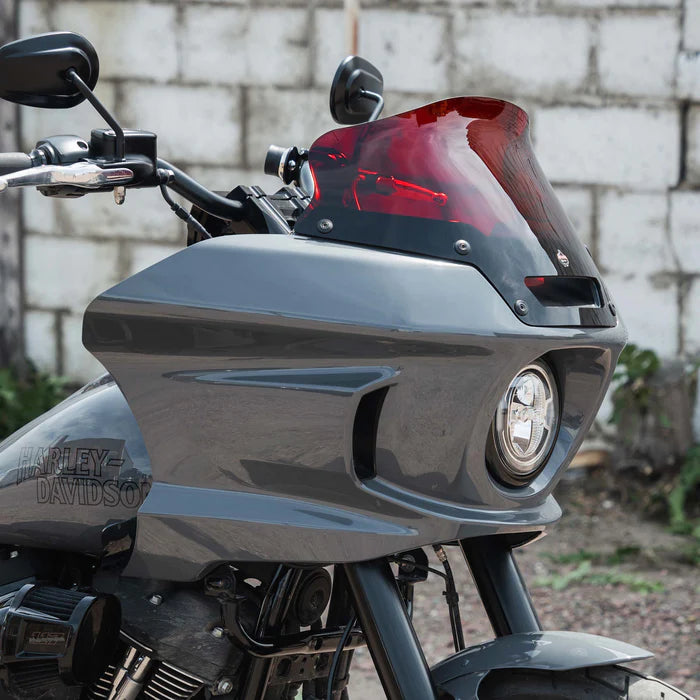
VTWIN HOT ROD 2:1 EXHAUST HARLEY DAVIDSON MODELS 84-11 DYNA SOFTAIL →
Total Time: 1-2 weekends for a full system, depending on complexity Difficulty: Intermediate to advanced
What You'll Need
- Mandrel-bent tubing in your chosen diameter
- Muffler and crossover of choice
- Exhaust hangers, clamps, and T-bolts
Step 1: Measure and Plan the Routing [Time: 2 hours]
Run a mock-up route with the car on stands. Check clearance at the frame rails, crossmember, and rear axle under suspension travel.
Expected Result: A routing that clears moving components through full suspension range.
Step 2: Cut and Fit the Sections [Time: 3-4 hours]
Cut tubing to length and tack-weld sections in place. Tack first, verify fit, then complete the welds.
Expected Result: A system that sits without tension or contact points.
Step 3: Install Hangers and Supports [Time: 2 hours]
Position hangers so the system can expand and move slightly with heat. Rigid mounting causes cracks at the weld seams.
Expected Result: A system that stays put but is not locked solid.
Step 4: Weld Out and Test [Time: 3 hours]
Complete all welds, check for leaks, and run the engine to temperature. Re-check clearances once everything is hot.
Expected Result: No leaks, no rattles, and a stable exhaust note.
Weight Reduction, Thermal Management and Heat Shielding
Weight and heat are the two constraints competitors ignore, and both affect real performance. Stainless systems often weigh more than the mild steel they replace, so plan material thickness deliberately rather than defaulting to the heaviest option.
Thermal management protects everything near the exhaust. Heat shielding, whether a physical barrier or a coating, keeps exhaust gas temperatures from cooking wiring, fuel lines, and floor pans.
Conclusion: Planning Your Custom Exhaust Build
The hard part of a custom exhaust is not welding; it is deciding the configuration before you buy a single bend.
At THE SPEED SHOP CANADA, we stock the exhaust components hot rod and Harley builders actually run, including the VTWIN Hot Rod 2:1 exhaust for Dyna and Softail models with 1-3/4-inch 16-gauge header pipes and 18mm oxygen sensor bungs.
Frequently Asked Questions
How much does it cost to have a custom exhaust made?
Cost depends on materials, routing complexity and whether you fabricate it yourself. A pre-built 2-into-1 system like the VTWIN Hot Rod 2:1 exhaust for 1984-2011 Dyna and Softail models runs $1,199.95, while the Dirty Biker 2:1 Shovelhead system is $1,499.95 and is special order with a 4-8 week lead time. Add welding, hangers, heat shielding and finishing if you go fully custom, plus labour if a shop does the fabrication.
What are the performance benefits of custom exhaust headers?
Headers set the exhaust gas velocity and scavenging that pull burnt gases out of the combustion chamber. Mandrel-bent 1-3/4 inch primaries flowing into a properly sized collector reduce backpressure and support the torque curve, especially when paired with intake and tuning changes. On a hot rod, matching primary length and tubing diameter to your engine displacement and rpm range matters more than bolting on the largest pipe you can find.
What are the legal requirements for vehicle exhaust noise levels in Canada?
Exhaust noise rules are set provincially and municipally, and they vary. Most provinces require a functioning muffler and set a decibel limit measured at a specified distance and rpm. Before installing a straight-through or unbaffled system, check your provincial highway traffic act and local bylaws. Collector-style pipes with no baffle can fail a roadside inspection even when they sound great.
Stainless steel vs aluminized steel: which is better for hot rods?
T-304 stainless steel resists corrosion far better and holds up to repeated heat cycles, which matters on a vehicle that sits outside or sees rain. Aluminized steel costs less and works fine for a fair-weather build, but the coating degrades over time. If you are already paying for custom fabrication, stainless is usually worth the extra spend because the labour cost is identical either way.
How do I choose the right exhaust pipe diameter for my engine?
Match tubing diameter to engine displacement and where you want power. Too large and you lose exhaust gas velocity and low-end torque; too small and you choke the top end. Many Harley-based hot rod builds run 1-3/4 inch headers into a 2-into-1 collector, which balances scavenging and backpressure. If you are unsure, tell the shop your engine specs and target rpm range before ordering.
Can I build my own exhaust system at home?
Yes, if you have the right tools: a tubing bender or pre-bent mandrel sections, a MIG or TIG welder, a chop saw, hangers and heat shielding. The trade-off is time and fitment. Off-the-shelf systems like the Dirty Biker 2:1 for Shovelhead and Panhead models include T-bolts and slider channels but no mounting brackets, so you still fabricate brackets and confirm chassis clearance yourself.
What is a ghost pipe exhaust and how does it function?
A ghost pipe is a dummy pipe that mirrors the look of a real exhaust on the opposite side without carrying exhaust gas. It is common on builds where a true dual system will not clear the chassis, oil tank or rear wheel. You get the visual symmetry of dual exhaust with the flow and tuning of a single 2-into-1 system, which is why it shows up on custom hot rods and bobbers.
How do I reduce exhaust drone without killing the sound?
Drone comes from resonance at cruising rpm. A chambered or baffled muffler, a resonator ahead of the muffler, or an H-pipe and X-pipe crossover can break up that resonance. Tailpipe tips and turnout ends also shape the exhaust note. Keep the collector baffled if you want a street-friendly tone; unbaffled collectors are louder and often fail noise checks.