
Upgrading Older Harley Engine Performance: A How-To Guide

Table of Contents
- Step 1: Set Your Riding Goals and Budget Before You Buy Parts
- Step 2: Run a Harley Engine Compression Test to Baseline the Engine
- Step 3: Start With a Harley Air Cleaner and Exhaust Upgrade
- Step 4: Plan Your Harley Cam Upgrade and Cam Chest Work
- Step 5: Add Displacement With a Big-Bore Kit for Bigger Gains
- Step 6: Harley Engine Tuning After Upgrades Is Not Optional
- Reliability, Cost, and Legal Checks for Older Harley Engine Performance Builds
- Common Mistakes to Avoid When Upgrading Older Harley Engine Performance
- Frequently Asked Questions
Last Updated: October 19, 2026
Step 1: Set Your Riding Goals and Budget Before You Buy Parts
The best Harley engine performance plan starts with one question: what do you want the bike to do?
Here is the short answer. Define your goal, then set a total installed budget, not a parts budget.
- Street rider: strong low-end torque and midrange power you feel every ride
- Weekend cruiser: a mild cam and better airflow, no wild compression
- Peak-power build: head work, big-bore kit, and a dyno tune to match
Labor is the hidden cost. A cam chest job and a big-bore kit both add hours of shop time. Budget for gaskets, fluids, and a tune as well.

Step 2: Run a Harley Engine Compression Test to Baseline the Engine
A Harley engine compression test tells you whether the engine is healthy enough to upgrade.
The test is simple and cheap: warm the engine, pull the plugs, crank each cylinder with a gauge, and compare readings.
What the numbers tell you:
- Even readings in spec: the engine is a good base for upgrades
- One cylinder low: suspect rings, valves, or a head gasket
- Both cylinders low: plan a top-end rebuild before any performance parts
A leak-down test confirms where pressure escapes. Do this before spending a dollar on performance parts, a tired engine will not hold up to a cam or big-bore kit for long.
Step 3: Start With a Harley Air Cleaner and Exhaust Upgrade
The first real power step on most older bikes is a Harley air cleaner and exhaust upgrade.
A high-flow air cleaner feeds more air in and a freer-flowing exhaust lets it out.
What to expect from Stage 1:
- Better throttle response
- Stronger midrange pull
- A sound and look that match the bike's character
Fit matters on older models: a Twin Cam kit will not fit an Evolution engine. Confirm the part number against your bike's model year and engine family before ordering.
Step 4: Plan Your Harley Cam Upgrade and Cam Chest Work
A Harley cam upgrade is the biggest single jump in usable power for most riders.
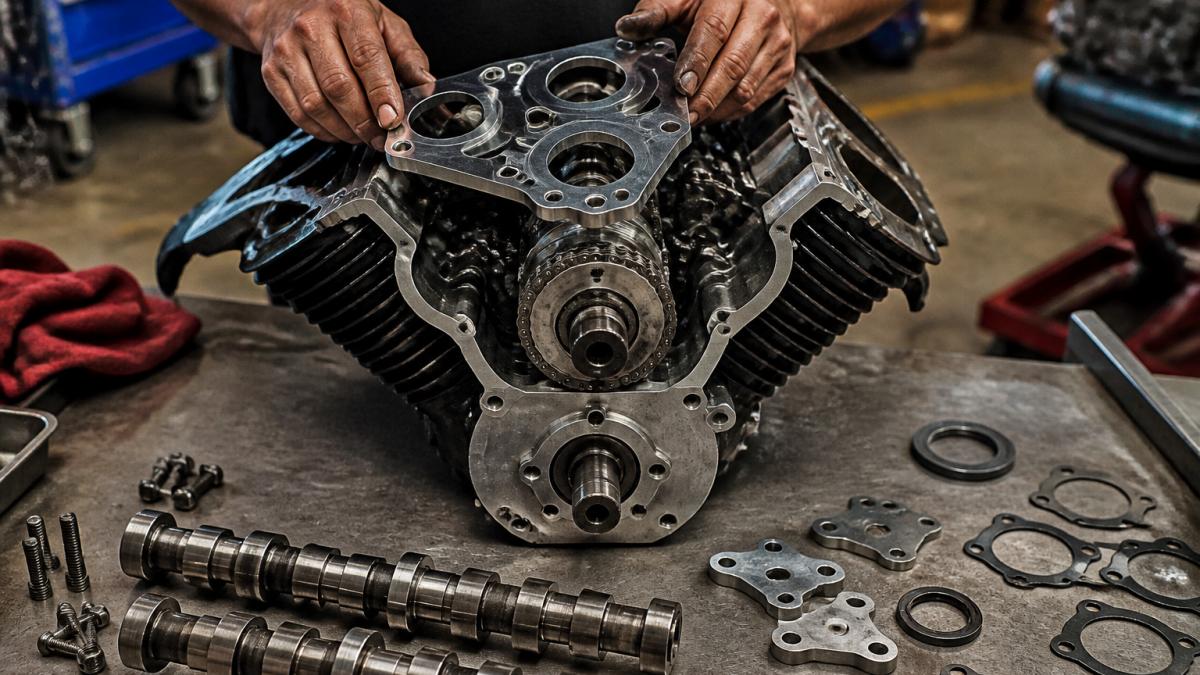
While you are in there, update the cam chest. Older Twin Cam tensioners wear, and the stock oil pump and bearings have limits.
We stock the ZIPPERS PERFORMANCE BLUEPRINT CAM CHEST UPGRADE KITS HARLEY 99-17 at $2,099.95.
For a race-focused build, the FUELING PERFORMANCE RACE SERIES CAM CHEST KIT HARLEY TWIN CAMS 00-17 at $3,349.95 adds camshafts, Race Series lifters, and an install kit.

Cam Selection: Matching Grind to Your Riding Style
Cam choice comes down to where you ride, not bragging rights. A big cam that makes power up high can feel soft down low.
| Riding style | Cam character | Power delivery |
|---|---|---|
| Street and touring | Mild grind | Strong low-end torque, easy manners |
| Aggressive street | Mid-range grind | Pull from mid-to-upper RPM |
| Peak-power build | Big grind | High RPM horsepower, needs head work |
Match the cam to your compression and riding goals. A cam that is too big for stock compression will feel worse than the one you replaced.
Step 5: Add Displacement With a Big-Bore Kit for Bigger Gains
A big-bore kit adds displacement with larger cylinders and pistons, meaning more torque everywhere, the move when bolt-ons and a cam are not enough. Treat it as an engine-family decision, not a catalog decision.
Match the Kit to the Engine Family First
Older Harleys split into two broad families for big-bore purposes, and parts do not cross over:
- Evolution engines: kits are sized around the stock 80" platform and use their own cylinder, piston, and gasket sets. Head and cam chest architecture differs from Twin Cam, so a Twin Cam kit will not fit.
- Twin Cam 88" (1999-2006): the common move is an 88" to 95" or 100" kit. Crankcase and cylinder spigot dimensions set the ceiling.
- Twin Cam 96"/103" (2007-2017): kits typically take these to 107", 110", or larger. Later Twin Cams also carry different flywheel and compensator designs, which affects how much added torque the bottom end will tolerate.
Confirm model year, engine family, and stock displacement before ordering: a 1999-2006 Twin Cam kit will not fit a 2007-and-later bike, and an Evolution kit shares almost nothing with either.
ZIPPERS PERFORMANCE BLUEPRINT CAM CHEST UPGRADE KITS HARLEY 99-17 →
What the Kits We Carry Cover
The S&S kits we stock are bolt-in. No machining, balancing, or splitting the crankcases, and the job can be done with the engine still in the frame.
- S&S CYCLE 100" TWIN CAM BIG BORE KIT HARLEY 99-06 TWIN CAMS at $2,699.95. It boosts an 88" engine to 100", or a 96"/103" to 110".
- S&S CYCLE 110" BIG BORE KITS FOR HARLEY DAVIDSON 07-17 TWIN CAMS at $2,499.95. Same bolt-in design for later Twin Cams.
Both kits run 10.5:1 compression with stock 85cc heads, keeping them streetable and dependable, and both respond well to a performance cam, plan the two together.

Supporting Parts a Big-Bore Build Actually Needs
Displacement raises cylinder pressure and heat, and the stock parts around it were sized for less. Budget for these alongside the kit:
- Cam and cam chest: a big-bore kit with a stock cam leaves torque on the table. Pair the kit with a cam grind matched to the new compression, and update tensioners, bearings, and the oil pump while the cam chest is open.
- Clutch: a stock clutch behind a 100"-plus build will slip or wear early. A heavier spring or a complete clutch upgrade is a common companion purchase.
- Compensator: added torque hammers the compensator. Inspect it during the build and replace a worn unit rather than waiting for failure.
Displacement Versus Bolt-Ons: When It Is Worth It
A cam and Stage 1 will wake up an older engine for far less money. Big-bore earns its cost when you want torque across the whole RPM range, plan to keep the bike long-term, and will fund the supporting parts and tune. For passing power alone, a cam and tune may be the better spend; for a noticeably bigger engine that pulls from idle to redline, displacement is the move, provided the rest of the build is planned around it.
Step 6: Harley Engine Tuning After Upgrades Is Not Optional
Harley engine tuning after upgrades is what turns parts into power. Skip it and you leave gains on the table, or run lean and risk damage.
A dyno tune adjusts fuel and timing to match your intake, exhaust, cam, and displacement, and proves what the build actually delivers instead of guessing from the seat.
What a proper tune gives you:
- Correct air/fuel ratio across the RPM range
- Clean throttle response and better cold starts
- A baseline dyno sheet to compare future changes
Plan the tune as the final step, after every part is installed. A tune done halfway through a build has to be redone.
Reliability, Cost, and Legal Checks for Older Harley Engine Performance Builds
Reliability is where older Harley engine performance builds earn or lose their reputation. More power loads the clutch, compensator, and oil system, so supporting modifications matter as much as the headline parts. Here is what added power stresses, what a build really costs installed, and what the rules require where you ride.
How Added Power Stresses the Rest of the Engine
Every performance part shifts load somewhere else. Plan for these, not just the headline gain:
- Heat: more compression and displacement raise combustion temperatures. A tired oil cooler, a marginal oil pump, or old coolant passages (where applicable) become the weak link. Confirm oiling capacity matches the build.
- Clutch and driveline: torque is what slips a stock clutch. A heavier spring or a full clutch upgrade is a common companion to a cam or big-bore build. The compensator and belt drive take the same hit.
- Fueling: lean conditions damage pistons and valves. A dyno tune that matches the new airflow and displacement is the cheapest insurance in the build.
Realistic Installed Cost by Stage
Parts are only part of the picture. Labor, gaskets, fluids, and tuning add up, and the tune is the line item riders most often forget. The table below frames total installed cost, not the sticker price of one part.
| Build stage | Typical parts | What the installed cost includes |
|---|---|---|
| Stage 1 | Air cleaner, exhaust, tuner | Parts, install labor, and a tune or tuner calibration. Lowest cost, best value per dollar. |
| Cam chest | Cam kit, bearings, gaskets, lifters | Parts plus several hours of shop labor, fluids, and a retune. |
| Big bore | Cylinders, pistons, gaskets, cam, clutch | Parts, significant labor, tune, break-in oil change, and follow-up check. |
| Full build | Heads, big bore, cam, clutch, tune | Highest parts cost, longest labor, dyno time, and a break-in and verification schedule. |
A practical rule: budget the tune and supporting parts as part of the stage, not an afterthought. Riders who price only the headline part run out of budget and skip the tune or clutch, both of which shorten the build's life.
Emissions, Noise, and Legal Checks
Exhaust and tuning changes can run into local rules that vary by province and municipality. Before you buy:
- Noise: many jurisdictions set exhaust sound limits and enforce them at roadside inspections. A loud system that passes at the shop may fail on the street.
- Emissions: some areas require emissions testing or restrict removal of emissions equipment. Confirm what applies where the bike is registered and ridden.
- Warranty and resale: aftermarket parts can affect manufacturer warranty coverage and resale. Keep receipts and documentation of the build.
Check the rules for your area before committing to an exhaust or tuning package, confirming first is far cheaper than reversing a purchase later.
Common Mistakes to Avoid When Upgrading Older Harley Engine Performance
The most common mistakes are planning errors, not parts failures. Avoid these and your build runs better and lasts longer.
- Buying parts before setting a goal. You end up with a mismatched combo.
- Skipping the compression test. You build on a worn engine and blame the parts.
- Ignoring model-year fitment. Twin Cam and Evolution parts do not swap.
Building real power from an older Harley takes the right sequence and the right parts, and guessing at fitment costs time and money. As a Drag / Parts Canada dealer, we help you match parts to your model year before you order.
Frequently Asked Questions
Should I upgrade the intake, exhaust, or cam first on an older Harley?
Start with the intake and exhaust together, then tune. That is the classic Stage 1 and it gives the engine airflow it can actually use. A cam upgrade only pays off once the engine breathes properly, so doing cams first on a stock air cleaner and exhaust usually leaves power on the table. If your compression test shows a healthy engine and your budget allows, combine Stage 1 with a cam chest kit so you pay for the teardown once.
Does a Harley engine need tuning after performance upgrades?
Yes. Any change to airflow, exhaust, cam timing, or displacement shifts the fuel and ignition requirements. Skipping Harley engine tuning after upgrades can cause lean running, poor throttle response, heat, and detonation that damages pistons. Budget for a proper tune or flash as part of every stage, not as an optional extra. A dyno session also confirms the gains are real rather than just louder.
How can I tell whether an older Harley engine is ready for upgrades?
Run a Harley engine compression test and a leak-down check before buying parts. Consistent, in-spec numbers across both cylinders mean the rings and valves are sealing well enough to build on. Low or uneven readings point to worn top-end components that should be fixed first. Also check cam chain tensioner wear on Twin Cam engines, since a failed tensioner can take out the whole cam chest.
How much horsepower can performance upgrades add to an older Harley?
Gains depend on the engine family, the parts chosen, and the tune. A Stage 1 intake, exhaust, and tune typically wakes up throttle response and midrange without changing displacement. A cam chest kit adds more mid-to-upper RPM pull. A big-bore kit is the largest single jump, since kits like the S&S 100-inch take an 88-inch Twin Cam to 100 cubic inches. Real numbers come from dyno results on your specific build, not from a generic chart.
Quote of the Day
Style is more than what we wear or how we decorate our spaces — it’s the freedom to choose what reflects who we are. Every design, every detail, is crafted with intention: to inspire joy, to add meaning, and to transform the everyday into something extraordinary. Because when comfort meets elegance, life itself feels more beautiful.
Brand Description
At our core, we believe that style should feel effortless yet meaningful. Each collection is carefully designed with attention to detail, blending modern aesthetics with everyday comfort. From timeless silhouettes to refined textures, our pieces are crafted to inspire confidence and elevate the way you live and dress. More than fashion, it’s a lifestyle made for you.