
Table of Contents
- Quality Motorcycle Parts vs Knockoffs: What Riders Need to Know
- OEM Motorcycle Parts Benefits: Why Genuine Components Cost More
- How to Identify Counterfeit Motorcycle Parts Before You Install Them
- The Risks of Cheap Motorcycle Exhaust Systems
- Critical vs. Cosmetic Parts: Where Knockoffs Do the Most Damage
- Verifying Parts on Online Marketplaces
- Warranty, Legal, and Cost Considerations
- Frequently Asked Questions
Last Updated: October 2, 2026
Quality Motorcycle Parts vs Knockoffs: What Riders Need to Know
Quality motorcycle parts vs knockoffs is the difference between a component engineered, tested, and certified to perform under load and one reverse-engineered to look correct in a photograph. A genuine part carries traceable materials, documented tolerances, and a manufacturer's warranty; a knockoff carries none of those, and that gap gets measured in braking distance, heat cycles, and structural failure.
The stakes are not cosmetic: a counterfeit brake lever or sub-standard exhaust header can fail at speed, and rarely gradually.
Not every part deserves the same scrutiny, but the ones that do deserve all of it.
| Part Category | Counterfeit Risk | Failure Consequence | Verification Priority |
|---|---|---|---|
| Brakes, levers, master cylinders | High | Loss of stopping power | Critical |
| Suspension and steering | High | Loss of control | Critical |
| Engine internals, cams, pistons | Medium-High | Catastrophic engine damage | High |
| Exhaust headers and mufflers | Medium | Heat damage, fitment, noise compliance | Medium |
| Air filters and intakes | Medium | Contamination, poor tuning | Medium |
| Mirrors, pegs, cosmetic trim | Low | Cosmetic only | Low |
OEM Motorcycle Parts Benefits: Why Genuine Components Cost More
OEM motorcycle parts are manufactured to the original equipment specification, either by the vehicle maker or by a supplier producing to that maker's drawings and tolerances.
OEM benefits worth paying for:
- Documented material integrity and tensile strength specifications
- Manufacturing tolerances held to original drawings
- Fitment guaranteed for the stated model and year
- Warranty coverage through the dealer network
- Compliance with applicable safety standards
That said, OEM isn't the only legitimate path. Reputable aftermarket manufacturers who publish their own specs and stand behind their products are valid for many builds. The distinction that matters is engineering accountability, not the label.
How to Identify Counterfeit Motorcycle Parts Before You Install Them
Spotting a counterfeit comes down to packaging, finish, and traceability.
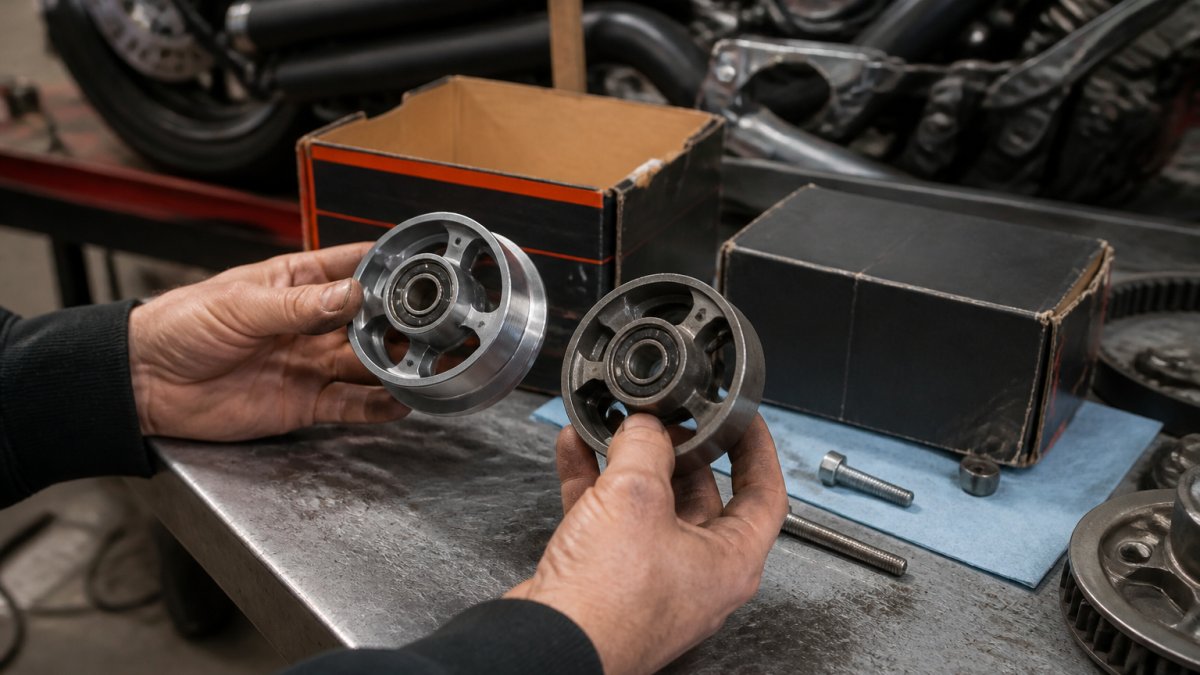
Run every suspect part through this checklist before it touches your bike:
- Compare the part number against the manufacturer's official catalog
- Inspect packaging print quality, font consistency, and spelling
- Look for a QR code or authentication label, and scan it
- Check the finish: rough casting, uneven plating, and flashing are red flags
- Weigh the part if you have a genuine one to compare
- Confirm certification marks are present and correctly formatted
- Verify the seller is an authorized dealer or a known distributor
The weight check catches more counterfeits than almost anything else. Sub-standard parts often substitute cheaper alloys, and the difference shows on a scale.
A Verification Protocol for Online Marketplaces
Marketplaces are where counterfeits concentrate, because listing is cheap and the seller is often anonymous.
Step 1, Identify the seller entity, not the storefront name. A storefront called "Genuine Moto Parts" tells you nothing.
Step 2, Confirm the seller is authorized for that specific brand. Authorization is brand-by-brand, not store-wide.
A price far below every other listing is the loudest warning sign.
The Risks of Cheap Motorcycle Exhaust Systems
Cheap exhaust systems carry risks from annoying to dangerous: poor fitment, thin-wall tubing that cracks under vibration, inadequate heat shielding, and noise levels that fail local bylaws. A sub-standard exhaust can also throw off fuel tuning, running the engine lean and raising combustion temperatures.
Fitment is where most budget systems fall apart first. Mounting points that don't line up force stress onto headers and flanges, and that stress becomes a crack.
The noise question matters too. Many jurisdictions enforce sound limits, and an exhaust that fails a roadside check means a fine and a forced swap. If you're building for the street, verify the system meets local sound requirements.
Where a cheap system can cost you:
- Cracking at welds and flanges from vibration
- Lean running conditions that damage valves and pistons
- Heat damage to nearby components from poor shielding
- Failed noise compliance checks
- Voided coverage on related engine repairs
Critical vs. Cosmetic Parts: Where Knockoffs Do the Most Damage
The knockoff damage hierarchy is the most useful framework for a build budget. Critical components control stopping, steering, and structural integrity; cosmetic accessories change how the bike looks. Spending on genuine parts should follow that order, every time.
Critical components include brakes, levers, master cylinders, suspension, steering bearings, and anything load-bearing. A failure here can be immediate and total. Cosmetic accessories include mirrors, pegs, trim, and aesthetic covers. A cheap mirror is an inconvenience. A cheap brake lever is a hazard.
| Tier | Examples | Knockoff Risk Level | Recommendation |
|---|---|---|---|
| Critical | Brakes, suspension, steering | Severe | Genuine or certified only |
| High | Engine internals, drivetrain | Serious | Reputable brands with specs |
| Medium | Exhaust, intake, electrical | Moderate | Verify seller and warranty |
| Cosmetic | Mirrors, trim, covers | Low | Budget-friendly options acceptable |
Buy the safety-critical parts first, and buy them right.
Verifying Parts on Online Marketplaces
Online marketplaces are where counterfeit parts concentrate, because the barrier to listing is low and the seller is often anonymous. Treat every marketplace listing as unverified until you've done the work.
Verification protocol for marketplace purchases:
- Check whether the seller is an authorized dealer for the brand
- Cross-reference the part number against the official catalog
- Look for a QR code or authentication feature and confirm it
- Read reviews specifically for authenticity complaints, not just shipping speed
- Confirm the return policy before you buy
- Pay through a method with buyer protection
Warranty, Legal, and Cost Considerations
Warranty and legal exposure are the hidden costs of knockoff parts, and they rarely show up until something goes wrong.
How Aftermarket Parts Affect a Factory Warranty
A common misconception is that installing any non-OEM part voids the entire warranty.
That distinction matters. If you install an aftermarket exhaust and your transmission fails, the exhaust is unlikely to be the cause and the transmission claim should stand.
The practical rule: the further a part is from the failed component, the weaker the manufacturer's case for denial; the closer it is, the stronger their case.
What manufacturers and dealers typically look at when a claim is questioned:
- Whether the failed component is original or aftermarket
- Whether the aftermarket part is in the same system as the failure
- Whether the part was installed correctly and by whom
- Whether the part meets the original equipment specification
- Whether there is evidence the modification caused the failure
Insurance Implications
Insurance is a separate question from warranty, and it is where riders are most often surprised.
Insurers generally assess claims on the facts of the loss. If a counterfeit or sub-standard part contributed to a collision, the insurer may pay the third-party claim but pursue recovery from the policyholder, or deny coverage for the damaged vehicle depending on the policy wording.
A practical step: if you have installed significant aftermarket components, tell your insurer. Many policies allow modifications if they are disclosed. Undisclosed modifications are where claims get complicated.
Consumer Protection and Recourse
Canadian consumer protection law gives buyers rights against deceptive sellers, including a remedy when goods are not as described. The challenge is enforcement: a marketplace seller in another jurisdiction is difficult to pursue, and the cost of a legal remedy often exceeds the value of the part.
Where recourse is realistic:
- Purchases from a Canadian retailer with a physical presence
- Purchases paid by credit card, where a chargeback may be available
- Purchases through a platform with its own buyer protection program
Where recourse is impractical:
- Anonymous marketplace sellers with no verifiable business address
- Sellers who required payment outside the platform
- Purchases where the buyer cannot prove what was advertised
This is the strongest argument for buying from a seller you can identify and hold accountable. The legal right exists; the practical ability to use it depends on who is on the other side.
The True Cost Math
The upfront saving on a knockoff is real. The offsetting costs are too, and they compound.
Where the true cost shows up:
- Voided warranty coverage on related repairs
- Repeat labor for a job done twice
- Collateral damage to adjacent components
- No recourse against an anonymous seller
- Potential liability if a failed part causes injury
- Higher insurance premiums or denied claims after a modification-related loss
A part that fails early and takes a related component with it costs more than the genuine version ever would have.
For riders building over time, financing matters.
If you're unsure whether a part fits your build, ask before ordering. A catalog can't tell you whether a component will work with your existing setup, but a team that builds bikes can.
Frequently Asked Questions
How can I distinguish between genuine OEM parts and knockoffs?
Check the packaging for holographic seals, QR codes, and precise part numbers. Genuine OEM motorcycle parts have consistent casting marks, smooth finishes, and correct weight. Counterfeits often have misspellings, flimsy boxes, and parts that feel lighter or rougher. If the price is far below dealer rates, treat it as a red flag. When buying online, stick to authorized dealers or reputable shops that can verify the supply chain.
Do aftermarket parts void my motorcycle warranty?
In Canada, provincial consumer protection laws and the manufacturer's warranty terms govern. Generally, a part only voids the warranty if it causes the failure. For example, an aftermarket exhaust won't void your entire warranty, but if it leads to engine damage, the manufacturer may deny that specific claim. Always keep receipts and consider using certified aftermarket parts to maintain coverage.
What are the safety risks of using counterfeit motorcycle parts?
Counterfeit parts often use sub-standard materials like weak ABS plastic or low-grade metals that fail under stress. Brake pads may not stop reliably, and exhaust systems can crack or leak carbon monoxide. These failures happen without warning, increasing crash risk. In Canada, safety standards for vehicles and components are in place, but counterfeits bypass these. Always prioritize parts that meet or exceed OEM specifications for critical components like brakes, suspension, and steering.
Are there reliable alternatives to expensive OEM parts?
Yes, reputable aftermarket brands that follow manufacturing tolerances and use quality materials can be safe and cost-effective. Look for companies with a track record in powersports or Harley Davidson communities. They often provide better performance for less than OEM. However, for critical components, OEM or high-end aftermarket is worth the investment. Always verify the seller's reputation and return policy, and avoid no-name listings on marketplaces.
The hardest part of any build isn't finding parts, it's knowing which ones you can trust. Get that wrong on a brake or suspension component and the whole project is compromised. THE SPEED SHOP CANADA stocks specialized performance parts for Harley-Davidson, powersports, and hot rods, backed by flexible financing through Shop Pay, RBC PayPlan, and Sezzle, plus free shipping in Canada on orders over $200. Get started with THE SPEED SHOP CANADA and build with parts you don't have to second-guess.