
Financing Options for Motorcycle Builds

Table of Contents
- Understanding Financing Options for Motorcycle Builds
- Motorcycle Parts Financing: Dealer and Retailer Plans
- Personal Loan for Motorcycle Parts and Labor
- Custom Motorcycle Build Cost: Budgeting and Payment Staging
- Using a Motorcycle Financing Calculator to Plan Your Build
- Credit Requirements and Approval for Build Financing
- Comparing Financing vs. Paying Cash for Your Build
- Frequently Asked Questions
Last Updated: October 11, 2026
Understanding Financing Options for Motorcycle Builds
Financing options for motorcycle builds give enthusiasts the flexibility to invest in custom projects without depleting savings. Whether you're upgrading a Harley Davidson or constructing a complete custom machine, multiple financing avenues exist to spread costs across months or years. At THE SPEED SHOP CANADA, we offer flexible financing options to fund everything from engine modifications to custom exhaust systems.
The core challenge is matching your financing method to your build timeline. A complete custom build rarely happens overnight. Parts arrive in stages, labor gets paid as work completes, and unexpected upgrades emerge mid-project. Smart builders choose financing structures that accommodate this reality rather than forcing all costs upfront.
Motorcycle Parts Financing: Dealer and Retailer Plans
Many retailers offer point-of-sale financing specifically for parts purchases. Shop Pay, RBC PayPlan, and Sezzle are common options that let you split payments across multiple installments without applying for a traditional loan. These plans work best for single large purchases or clustered orders.
Dealer financing typically covers parts inventory and may include promotional periods with reduced interest rates. THE SPEED SHOP CANADA offers flexible financing options. The advantage here is simplicity: one application, one payment arrangement, and direct access to the retailer's full catalog.
The limitation is that dealer plans often cap at specific amounts and may not cover labor, shipping, or custom work. If your build spans multiple retailers, you'll need separate financing arrangements for each source.
Personal Loan for Motorcycle Parts and Labor
A personal loan from a bank or credit union provides broader flexibility than retailer-specific plans. You borrow a lump sum, then allocate it across parts, labor, tools, and contingencies as your build progresses. Interest rates depend on your credit profile and loan term.
Personal loans work well for builders who work with independent shops or have custom fabrication needs. Unlike dealer financing tied to specific inventory, a personal loan lets you shop across multiple suppliers and adjust spending based on what you find. You can also cover labor costs directly without the retailer acting as intermediary.
The trade-off is that personal loans typically require a formal application process and credit check. Approval timelines range from days to weeks, so planning ahead matters.
Custom Motorcycle Build Cost: Budgeting and Payment Staging
Effective budgeting for a custom build starts with itemizing every component and service. Engine work, transmission, frame modifications, wheels, exhaust systems, wiring, paint, and assembly labor each carry distinct costs. Many builders underestimate contingency, parts don't fit as expected, suppliers backorder items, or mid-build inspiration adds features.
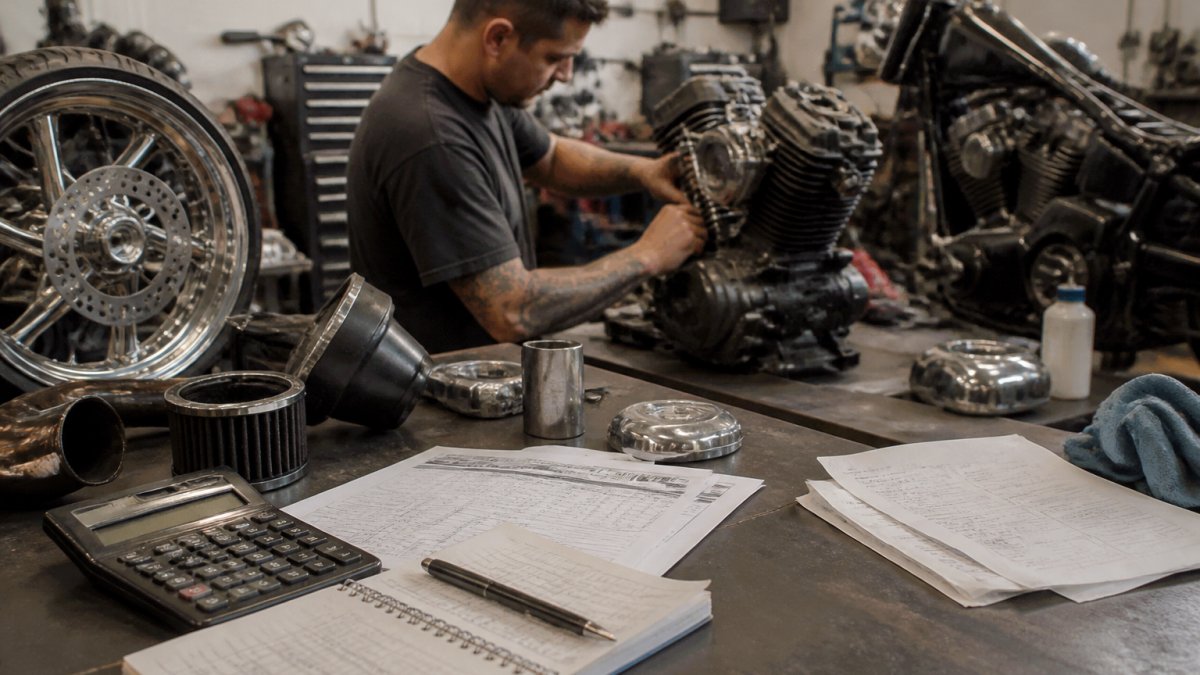
Staged payment financing aligns with how builds actually happen. Instead of financing the entire project upfront, you secure credit lines that activate as work progresses. Some builders use multiple smaller loans or credit cards rather than one large loan, matching drawdowns to project phases.
This approach reduces interest costs on money sitting idle and lets you adjust financing if the build scope changes. If you discover mid-project that a component won't work, you haven't already paid for it.
Using a Motorcycle Financing Calculator to Plan Your Build
A financing calculator shows how different loan amounts, interest rates, and terms affect monthly payments. Input your total build cost, your preferred monthly payment, and your target completion date. The calculator reveals what interest rate you need to achieve that payment or what payment you'll face at a given rate.
Most lenders provide calculators on their websites. Our financing partners often include calculators that model scenarios specific to powersports purchases. This tool helps you decide whether a shorter loan term with higher payments makes sense versus a longer term that spreads costs thinner.
Calculators also expose the true cost of borrowing. A $15,000 build financed at 8% over 60 months costs roughly $18,150 total. Over 36 months, the same build at the same rate costs roughly $16,650. The difference highlights how term length affects total interest paid.
Build-Specific Considerations Calculators Don't Always Show:
Custom motorcycle builds carry unique financial risks that standard calculators may not address. Parts delays, labor overruns, and mid-project design changes are common. A builder who estimates $15,000 but encounters a cracked frame, supplier backorder, or decides to upgrade the suspension mid-build can easily exceed budget by 20-40%. If you finance $15,000 at 8% over 60 months but the actual build costs $19,000, you've now borrowed beyond what the finished motorcycle may be worth on resale.
Use your calculator to model a contingency buffer, typically 15-25% above your base estimate. A $15,000 build with a 20% contingency means financing $18,000. This approach protects against overruns without forcing you to seek emergency funding mid-project. Some builders also use staged calculators: finance parts and labor in phases rather than as one lump sum, so you only pay interest on money as it's actually spent.
Another critical factor is the relationship between total borrowed amount and the bike's eventual resale or trade-in value. Lenders and insurance companies may assess a custom build's value differently than a stock motorcycle. If you borrow $20,000 for a build but the finished bike appraises at $16,000, you're underwater on the loan. Consult your lender about valuation expectations before committing to the full build scope.
Credit Requirements and Approval for Build Financing
Most lenders evaluate credit history, income, and debt-to-income ratio. Good credit typically qualifies for lower interest rates. Builders with fair or poor credit still access financing, but expect higher rates or stricter terms.
Some lenders specialize in powersports financing and work with borrowers across the credit spectrum. Pre-approval lets you shop knowing your budget and rate before committing to a specific build. Our financing partners can often provide pre-approval within hours.
Income verification and proof of employment are standard requirements. Self-employed builders may need tax returns or business statements. Having documentation ready accelerates the approval process.
Build-Specific Approval Challenges:
Custom motorcycle builds present approval complications that stock motorcycle purchases do not. Lenders typically require collateral for secured loans, meaning the finished motorcycle backs the debt. However, a partially completed build has no clear market value, no title, and no way to repossess or resell if the borrower defaults. This uncertainty makes many traditional lenders reluctant to offer secured loans on in-progress custom projects.
If you're financing a build, expect lenders to ask:
-
What is the finished bike's projected value? Lenders want assurance that the completed motorcycle will be worth at least the loan amount. A custom build with rare or high-end components may appraise higher, but heavily modified or experimental designs may struggle to find a resale market. Have documentation of comparable custom bikes or a professional appraisal estimate ready.
-
Will the bike have a clear title? A motorcycle built from a donor frame or engine may carry the original title, but custom frames or extensively modified bikes sometimes require a rebuilt or reconstructed title depending on provincial regulations. Lenders are cautious about titles that signal major modifications, as they affect insurance and resale.
-
Is the build being completed by a licensed shop or privately? Lenders feel more confident when a recognized shop oversees construction, as it suggests professional standards and documentation. Private garage builds raise red flags about quality, completion likelihood, and future insurability.
Financing Strategies for Custom Builds:
Unsecured personal loans sidestep collateral concerns but typically carry higher interest rates (often 7-15% depending on credit) (Personal loans). They don't require the lender to assess the bike's value or title status, making approval faster and less contingent on build specifics.
Alternatively, some builders use a hybrid approach: secure a personal loan for parts and labor, then refinance into a secured motorcycle loan once the build is complete, titled, and appraised. This allows you to start the project without proving the finished bike's value upfront, then lock in a lower rate once the motorcycle exists and can be inspected.
If working with a dealer or shop that offers in-house financing, ask whether they'll finance staged payments as work progresses rather than requiring full payment upfront. Some shops will invoice in phases, initial parts order, fabrication milestone, final assembly, and coordinate with a lender to release funds at each stage. This approach aligns borrowing with actual spending and reduces the risk of financing a project that stalls mid-way.
Comparing Financing vs. Paying Cash for Your Build
Paying cash eliminates interest charges and debt obligations. If you have savings set aside, using them avoids monthly payments and keeps your credit available for emergencies. This approach appeals to builders who prioritize simplicity and want to avoid financial risk.
Financing allows you to build now while preserving cash reserves. If a major expense emerges, vehicle repair, medical bill, home maintenance, you have liquidity. Financing also lets you spread a large project across your budget without financial strain.
| Financing Method | Best For | Key Trade-off |
|---|---|---|
| Dealer Plans | Single large parts orders | Limited to retailer inventory |
| Personal Loan | Multi-source builds, labor costs | Formal application, credit check |
| Staged Financing | Long-term projects, phased work | More complex management |
| Cash Payment | Immediate builds, no interest | Depletes savings, reduces liquidity |
The choice depends on your financial situation and build timeline. Many builders use a hybrid: cash for initial components, then financing for labor-intensive phases or unexpected upgrades.
Building a custom motorcycle demands careful financial planning. Whether you choose dealer financing, a personal loan, or staged payment arrangements, align your method with your build schedule and cash flow. THE SPEED SHOP CANADA offers multiple financing options, including Shop Pay, RBC PayPlan, and Sezzle, so you can select the approach that fits your project. Explore RBC's financing options for major purchases to compare terms, then get started on your build with confidence.
Frequently Asked Questions
Can you finance motorcycle parts and labor together?
Yes. Many lenders offer personal loans or lines of credit that cover both parts and labor costs for custom builds. Retailer financing plans often cover parts only, so combining a retailer plan for components with a personal loan for labor gives you flexibility. Some powersports lenders specialize in build financing and will fund the entire project in stages as work progresses, which helps manage cash flow during longer builds.
What credit score do you need to finance a motorcycle build?
Credit score requirements vary by lender. Traditional banks typically require 620 or higher for unsecured personal loans, while credit unions may approve lower scores. Retailer financing through platforms like Sezzle or Shop Pay often has more lenient credit checks. If your score is below 620, co-signers, larger down payments, or secured loans against existing assets can improve approval odds. Check with multiple lenders to find options that match your credit profile.
Is it better to finance a motorcycle build or pay cash?
Financing lets you start your build immediately and spread costs over time, preserving cash for emergencies. Paying cash avoids interest charges and debt. The choice depends on your interest rate, build timeline, and financial stability. If you can secure low-rate financing and have emergency savings, financing often makes sense. If your build is urgent and you have savings available, paying cash eliminates interest costs. Calculate the total cost of borrowing before deciding.
Can you use a personal loan to build a motorcycle?
Yes. Personal loans are flexible and can fund parts, labor, and tools for custom builds. They typically offer faster approval than specialized powersports loans and work with any retailer or mechanic. Interest rates depend on your credit score and lender. Personal loans are unsecured, so no collateral is required. Compare APRs across banks and credit unions to find competitive rates, and confirm the lender allows use for motorcycle projects before applying.
Quote of the Day
Style is more than what we wear or how we decorate our spaces — it’s the freedom to choose what reflects who we are. Every design, every detail, is crafted with intention: to inspire joy, to add meaning, and to transform the everyday into something extraordinary. Because when comfort meets elegance, life itself feels more beautiful.
Brand Description
At our core, we believe that style should feel effortless yet meaningful. Each collection is carefully designed with attention to detail, blending modern aesthetics with everyday comfort. From timeless silhouettes to refined textures, our pieces are crafted to inspire confidence and elevate the way you live and dress. More than fashion, it’s a lifestyle made for you.