
Custom Hot Rod Engine Performance: The Complete Guide

Last Updated: November 7, 2026
Quick Summary
Custom hot rod engine performance means matching displacement, airflow, camshaft profile, and drivetrain gearing to a specific vehicle and driving goal, not chasing one peak horsepower number. Three numbers decide whether you enjoy the result: torque where you actually drive, how power holds past its peak, and how much reaches the ground through the transmission and rear end.
- Choose the engine family by chassis fit, swap support, induction type, weight balance, and total cost.
- A crate engine usually excludes mounts, headers, cooling, fuel delivery, wiring, ECU calibration, and transmission parts.
- Match bellhousing pattern, torque capacity, converter stall, and rear gear before committing to a powertrain.
- Price the build in four buckets: engine and induction, installation hardware, drivetrain and chassis, and tuning and contingency.
- Prime the oil system and follow the camshaft break-in procedure before any hard driving.
Table of Contents
- What Custom Hot Rod Engine Performance Really Means
- Choosing the Best Engine for a Hot Rod
- Hot Rod Crate Engines vs Custom Builds
- Engine Family Comparison: Small-Block, Big-Block, LS, LT, and Coyote
- Planning an LS Engine Swap for Hot Rods
- Engine and Transmission Compatibility: Matching the Whole Powertrain
- Performance Metrics Beyond Peak Horsepower
- Build Costs, Break-In, and Tuning Your Hot Rod Engine
- Frequently Asked Questions
What Custom Hot Rod Engine Performance Really Means
Custom hot rod engine performance means matching displacement, airflow, camshaft profile, and drivetrain gearing to a specific vehicle and driving goal, not chasing one peak horsepower number. Builders often fixate on a dyno figure and end up with a car that is miserable to drive.
Three numbers decide whether you enjoy the result: torque where you actually drive, how power holds past its peak, and how much reaches the ground through the transmission and rear end.
Choosing the Best Engine for a Hot Rod
The best engine for a hot rod fits your chassis, budget, and intended use, in that order. A big-block that will not clear the firewall is not a bargain, and neither is a 700-hp build with cooling sized for a stock small-block.
Start with the vehicle, not the catalog. Weight, engine bay dimensions, firewall and tunnel clearance, and rear axle ratio constrain the choice before horsepower enters the conversation.
A Practical Engine-Selection Decision Framework
Work through these in sequence and eliminate options at each step:
- Chassis fit: Measure the engine bay, firewall-to-radiator distance, and tunnel width. Eliminate anything that will not physically sit on your mounts.
- Intended use: Street, strip, or touring. Touring demands part-throttle manners and cooling capacity; strip builds tolerate a rough idle.
- Transmission and rear end: Match the engine's torque curve to your gearing. A cam that makes power at 6,500 rpm behind a tall highway gear feels gutless.
- Fuel and induction: Carbureted or fuel injected. EFI simplifies cold starts and altitude changes; carburetion keeps the build simple and cheaper.
- Budget ceiling, all-in: Engine, mounts, exhaust, cooling, fuel system, wiring, and tuning.
| Priority | Choose This | Why |
|---|---|---|
| Tight budget, mild build | Rebuilt small-block | Cheap parts, huge support |
| Modern street manners | LS or LT swap | Light, efficient, EFI standard |
| Maximum torque, period look | Big-block | Displacement and visual presence |
| Lightweight Ford build | Coyote | Compact, high-revving, modern EFI |
| Nostalgia with power | Stroker small-block | Stock footprint, more cubes |
Hot Rod Crate Engines vs Custom Builds
A crate engine typically arrives assembled; a custom build is assembled to your specification, usually by you or a local machinist. Crate engines remove assembly risk and shorten the timeline.
A crate engine is often a practical choice for a first build or a season deadline, while custom assembly suits a second build, once you know what you want and have a machinist you trust.
What a Crate Engine Includes and What It Doesn't
Most crate engines ship as a long block or turnkey assembly.
A crate engine usually excludes engine mounts, headers, cooling system, fuel delivery, wiring harness, ECU calibration, and transmission mating parts.
For a concrete example of a high-output turnkey-style option, our S&S Cycle 136 Black M8 crate engine for 2017-2026 Harley-Davidson models shows what a complete factory-assembled package looks like.

Engine Family Comparison: Small-Block, Big-Block, LS, LT, and Coyote
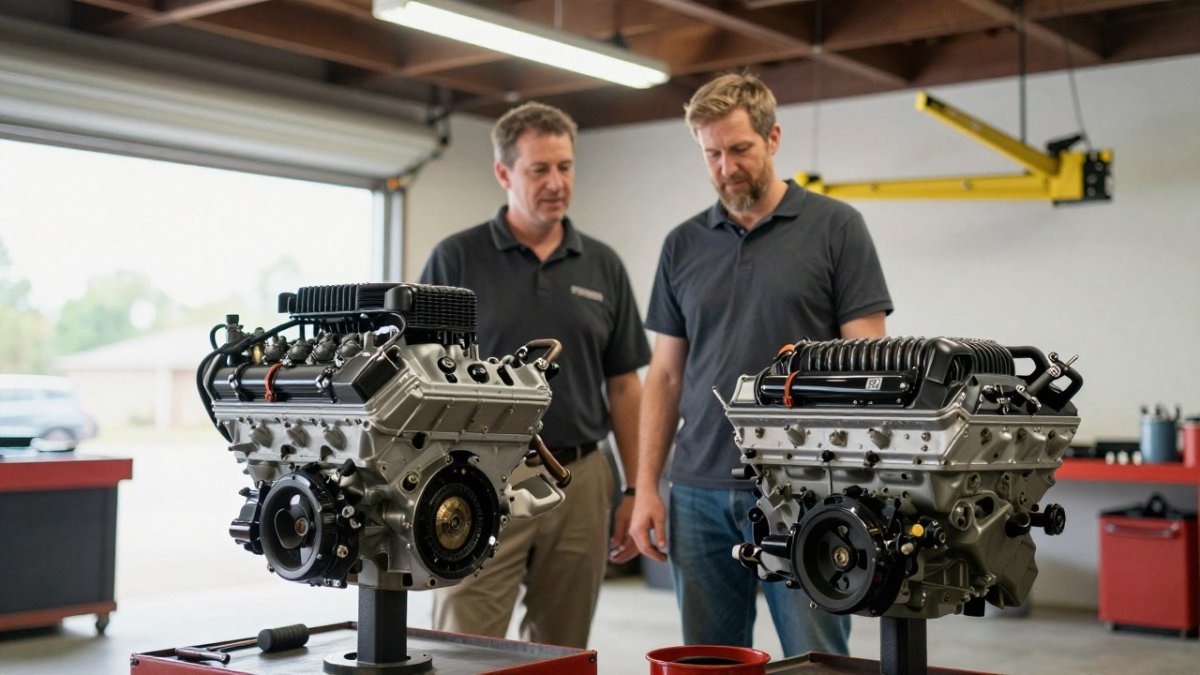
The engine family decision drives everything downstream: mount kits, header availability, transmission adapters, wiring, cooling, and total cost. Treat it as a packaging and support decision first, a horsepower decision second.
What Actually Separates the Families
- Small-block (traditional pushrod V8): The most supported platform in the aftermarket, with off-the-shelf mounts, headers, bellhousing adapters, and accessory brackets for almost any chassis. Iron blocks are heavy, but compact external dimensions make them the easiest fit in narrow bays and period-correct builds. Carbureted versions need no ECU, simplifying wiring but demanding more tuning attention.
- Big-block: Displacement and torque come with external bulk. The taller, wider block, larger heads, and longer header primaries make firewall, shock tower, and steering shaft clearance real constraints. Weight over the front axle changes handling and braking balance, which matters more on a street car than a strip car.
- LS: Aluminum blocks and heads cut weight versus an iron small-block, and factory EFI and coil-near-plug ignition are well understood. The trade-off: swap parts, mounts, oil pan, accessory drive, harness, ECU calibration, often cost more than the used engine itself. Support is deep, so parts exist; budget is the constraint.
| Family | Strength | Trade-off | Best For |
|---|---|---|---|
| Small-block | Cheap, compact, universal support | Needs work for big power | Budget builds, period-correct cars |
| Big-block | Torque and visual presence | Heavy, tight fit | Muscle builds, drag cars |
| LS | Light, efficient, EFI | Swap wiring and accessory cost | Modern street rods |
| LT | Direct injection, strong midrange | Fewer budget swap parts | Newer builds with EFI budget |
| Coyote | High-revving, compact | Wider than it looks in some bays | Lightweight Ford builds |
A Decision Rule That Beats Browsing
Work through the families in this order and stop at the first one that clears every gate:
- Will it physically fit? Measure engine bay length, width, and height, plus firewall-to-radiator distance and steering shaft routing. A family that fails here is out regardless of price or power.
- Does the chassis have off-the-shelf swap support? Check whether mount kits, headers, and transmission adapters exist for your chassis and engine family. Fabricating all three adds significant time and cost.
- Does the induction type match your skill and budget? Carbureted builds are simpler to wire but demand jetting and choke knowledge. EFI builds need a harness, an ECU strategy, and a tuner.
- Does the weight and balance suit the car? An all-iron big-block in a light chassis changes its character; an aluminum LS or Coyote keeps weight closer to original.
- Is the total swap cost inside your ceiling? Price the engine plus mounts, pan, accessory drive, harness, cooling, exhaust, and tuning before committing.
Watch out: buying an engine because it was cheap and then discovering no mount kit or header exists for your chassis is the most common way a budget swap stalls for a season.
If you are leaning toward a V-twin platform, our S&S Cycle V124 HC Evolution crate engine for 1984-1999 Harley-Davidson models is a real example of what a high-displacement crate package includes.

Planning an LS Engine Swap for Hot Rods
An LS swap succeeds or fails on the details around the engine, not the engine itself. The block is cheap and plentiful; mounts, oil pan, accessory drive, wiring, and cooling are where budgets and timelines are made or lost.
Plan the swap around clearance first. Measure the firewall, steering shaft, and hood height before you buy anything.
Mounts, Oil Pans, and Accessory Drives
- Mounts: Choose a swap-specific mount kit for your chassis. Universal mounts plus adapter plates stack tolerances and usually create header and steering clearance problems.
- Oil pan: The pan must clear the crossmember and steering rack while keeping the pickup covered under acceleration. A pan that fits but starves on hard launches will cost you a bearing.
- Accessory drive: A compact drive keeps the front of the engine short and simplifies belt routing. Confirm alternator and power steering pump placement before ordering hoses.
A common mistake is buying the engine first and the swap parts last. Reverse that order and you will avoid the return shipping.
Engine and Transmission Compatibility: Matching the Whole Powertrain
Engine and transmission compatibility is the most overlooked part of a hot rod build. The torque curve, bellhousing pattern, converter stall speed, and rear axle ratio must work as one system.
Check three things before you commit:
- Bellhousing pattern and adapter availability for your engine-to-transmission pairing.
- Torque capacity of the transmission against the engine's output, with margin.
- Converter stall and rear gear matched to where the engine actually makes torque.
For builders upgrading the drivetrain alongside the engine, our Baker Direct Drive 7-speed transmission for 2007-2017 Harley Softail models is an example of matching an upgraded transmission to a higher-output power plant.
Performance Metrics Beyond Peak Horsepower
Peak horsepower is the least useful number in a street car. What matters is average torque across the rpm range you use, how quickly the engine builds revs, and whether cooling and fuel systems sustain output on a long drive.
Three metrics tell you more than a single peak figure:
- Area under the torque curve between idle and your shift point.
- Power under the curve past peak, which shows whether the engine keeps pulling or falls flat.
- Specific output per pound of engine weight, which matters more than most builders admit.
The exhaust side is where many builds leave power on the table. Our guide to custom exhaust systems for hot rods covers sizing, scavenging, and routing in detail.
Build Costs, Break-In, and Tuning Your Hot Rod Engine
Budget the whole project, not the engine. A realistic build cost covers the engine, mounts, headers and exhaust, cooling, fuel system, wiring, transmission work, rear end, and dyno tuning. The engine is often less than half the total, and on EFI swaps closer to a third once supporting parts are counted.
A Cost Framework You Can Actually Plan Around
Price the build in four buckets and add them before you buy anything:
- Engine and induction: The long block or turnkey engine, plus intake, carburetor or EFI system, ignition, and any machine work if you are building rather than buying.
- Installation hardware: Mounts, oil pan, accessory drive, headers, exhaust, cooling, fuel delivery, wiring harness, and transmission mating parts. This bucket is where first-time budgets go sideways because each item looks small on its own.
- Drivetrain and chassis: Transmission work, converter or clutch, rear axle ratio, driveshaft, and any brake or suspension upgrades the extra power demands.
- Tuning and contingency: Dyno time, a wideband oxygen sensor, replacement fluids, and a reserve for parts you discover mid-build.
A common pattern is that builders who price only buckets one and two run out of budget before tuning, then drive on a baseline calibration to save money. That is the most expensive shortcut in the project.
Break-In Sequence
Break-in follows a fixed sequence, and the order matters:
- Prime the oil system before first start so bearings are not dry during cranking.
- Verify timing and fuel pressure at the specified settings before the engine fires.
- Run the camshaft break-in procedure if required, holding the specified rpm for the specified time with the correct oil.
- Change the oil and inspect for debris after the initial run, then again after the first few hundred kilometers.
- Re-torque and re-check fasteners, valve lash if adjustable, and fluid levels before any hard driving.
Watch out: skipping the oil prime or the cam break-in procedure risks a flat cam or a bearing failure in the first hundred kilometers.
Tuning Comes Last and Should Never Be Skipped
A dyno session with a wideband oxygen sensor can confirm air-fuel ratio across the range and catch lean conditions early. Tune before you drive it hard. Running a fresh engine on a baseline tune to "see how it feels" is the fastest way to damage a new build.
Our Power Vision 3 mount kit is the mounting hardware for the tuning device we use to dial in the calibration.

Frequently Asked Questions
What is the best engine for a custom hot rod?
There is no single answer, because the best engine depends on the vehicle's weight, intended use, and your budget. A lightweight small-block or LS V8 suits street-driven rods that need manageable power and easy parts support. Big-block and stroker builds fit heavier cars or strip-focused projects where torque matters more than fuel economy. Match displacement and power output to the chassis before you buy anything.
How much horsepower does a hot rod need?
Most street-driven hot rods are enjoyable between roughly 300 and 500 horsepower, which is enough to feel quick without overwhelming street tires or cooling. Strip builds often push well beyond that. Peak horsepower is only part of the picture; torque curve shape, gearing, and vehicle weight decide how the car actually feels. Plan the whole powertrain around a realistic target rather than chasing a number.
Should I choose a crate engine or build a custom hot rod engine?
A crate engine arrives assembled and documented, which shortens the build and gives you a known baseline for tuning. A custom build lets you specify camshaft, compression, and heads for your exact application, but it takes more time and machine work. If you want predictable results and a faster turnaround, a crate engine is often the practical choice. If you have a specific target and an experienced machinist, a custom assembly can deliver more.
Are LS engines a good choice for a hot rod?
LS engines are popular for hot rods because they are compact, light, and widely supported with mounts, headers, and wiring solutions. They also make strong torque from a relatively small package. The main planning points are accessory drive clearance, oil pan shape, and transmission pairing. An LS engine swap for hot rods works best when you budget for the supporting parts, not just the engine itself.
How do I match an engine to a hot rod's transmission and rear end?
Start with the torque the engine will actually produce and choose a transmission rated above that figure. Then match rear-end gearing to your intended use: taller gears for highway cruising, shorter gears for acceleration. Engine and transmission compatibility also covers bellhousing bolt pattern, flexplate or flywheel balance, converter stall speed, and crossmember placement. Confirm each of these before ordering parts.
What should I consider before installing a high-performance engine in a hot rod?
Check cooling capacity, fuel delivery, braking, and chassis stiffness before adding power. A bigger radiator, upgraded fuel lines, and a properly sized exhaust system are common requirements. Confirm hood clearance for the intake and air cleaner, and verify that engine mounts and headers fit your specific chassis. Budget for dyno tuning and a proper break-in period so the engine performs as intended.

Quote of the Day
Style is more than what we wear or how we decorate our spaces — it’s the freedom to choose what reflects who we are. Every design, every detail, is crafted with intention: to inspire joy, to add meaning, and to transform the everyday into something extraordinary. Because when comfort meets elegance, life itself feels more beautiful.
Brand Description
At our core, we believe that style should feel effortless yet meaningful. Each collection is carefully designed with attention to detail, blending modern aesthetics with everyday comfort. From timeless silhouettes to refined textures, our pieces are crafted to inspire confidence and elevate the way you live and dress. More than fashion, it’s a lifestyle made for you.