
The Harley Davidson Performance Upgrades Guide

Last Updated: November 12, 2026
Quick Summary
Harley Davidson performance upgrades follow a staged sequence: Stage 1 adds a high-flow air cleaner, exhaust, and ECM recalibration, Stage 2 adds a camshaft, and Stage 3 and Stage 4 move into big bore cylinders and full engine builds. Each stage assumes the previous one is done, and the tune must match your exact parts combination.
- Stage 1 parts cost $680 to $2,100 CAD and are DIY friendly.
- Stage 2 adds a camshaft and typically costs $980 to $2,000 CAD.
- Stage 3 big bore kits start at $2,990 CAD and require engine work.
- Confirm engine family, displacement, cooling type, and model year before ordering parts.
- Aftermarket engine modifications can affect factory warranty coverage, so confirm with your dealer in writing.
Table of Contents
- How Harley Davidson Performance Stages Actually Work
- Stage 1: Intake, Exhaust, and the ECM Recalibration That Ties Them Together
- Stage 2: Camshaft Upgrades and What They Change
- Stage 3 and Stage 4: Big Bore Kits and Full Engine Builds
- Fuel Tuning and Dyno Tuning: Why the Tune Decides the Result
- Fitment, Warranty, Emissions, and Reliability by Stage
- Building Your Harley Davidson Performance Upgrades Plan
- Frequently Asked Questions
How Harley Davidson Performance Stages Actually Work
Harley-Davidson describes its Screamin' Eagle stage kits as improving acceleration and passing power over stock, and that framing is the clearest way into this harley davidson performance upgrades guide: stages are a sequence, not a menu.
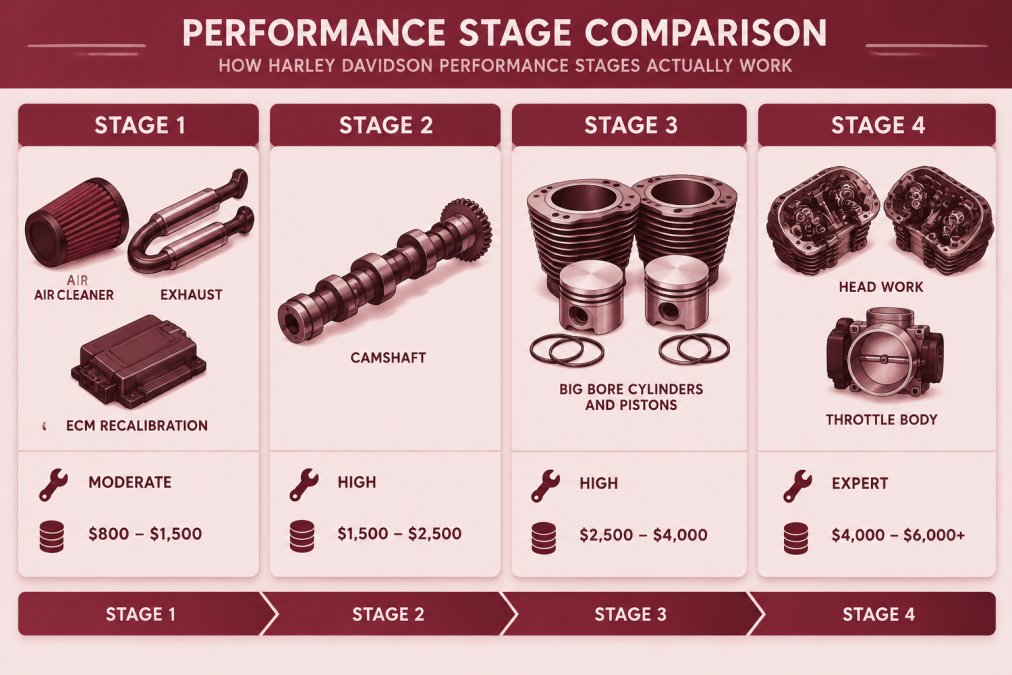
A performance stage is a defined bundle of engine modifications that work as a matched set. Stage 1 covers airflow in and out plus the tune that ties them together. Stage 2 adds a camshaft. Stage 3 and Stage 4 move into big bore cylinders and full engine builds.
What Each Stage Adds and What It Costs
Stage 1 is the entry point: a high-flow air cleaner, a less restrictive exhaust, and an ECM recalibration. According to Harley-Davidson's Screamin' Eagle performance overview, intake and exhaust changes require ECM recalibration to run correctly, which is why the tune belongs in the same purchase as the parts.
Stage 2 adds a camshaft and delivers the next major gain. Stage 3 and Stage 4 involve big bore cylinders, head work, and supporting components, and they are engine builds rather than bolt-on jobs.
| Stage | Typical Parts | Power Character | Install Difficulty | Parts Cost (CAD) |
|---|---|---|---|---|
| Stage 1 | Air cleaner, exhaust, tune | Sharper throttle, stronger midrange | Low, DIY friendly | $680 to $2,100 |
| Stage 2 | Camshaft, gaskets, tune | Noticeable torque gain across rev range | Medium, specialist job | $980 to $2,000 |
| Stage 3 | Big bore cylinders, pistons, tune | Large displacement-driven gain | High, engine work | $2,990 and up |
| Stage 4 | Big bore plus head work, throttle body | Maximum output, dedicated build | High, machine shop involved | Quote per build |
Stage 1: Intake, Exhaust, and the ECM Recalibration That Ties Them Together
The tune is an essential part of Stage 1. A high-flow air cleaner and freer-flowing exhaust change how much air moves through the engine, but the ECM still fuels for stock airflow until recalibrated, so the parts alone leave performance on the table.
High-Flow Air Cleaners and Air Filters
A high-flow air cleaner replaces the stock intake with a larger filter and smoother path into the throttle body. The K&N RK-3954B Street Metal Intake System is a good example: oversized filter, aluminum backing plate with integrated velocity stack, and built-in breathers. It fits select 2017 Harley-Davidson models, including the Street Glide, Road Glide, and Road King.
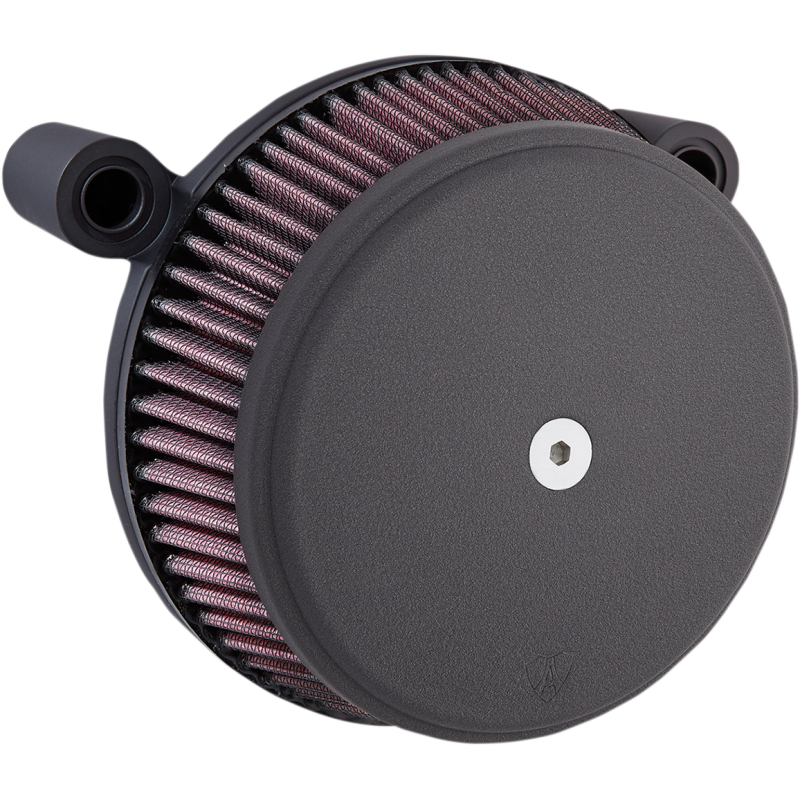
Watch out: buying an air cleaner without budgeting for the tune turns a Stage 1 into a cosmetic upgrade with a lean-running risk.
Slip-On and Full Exhaust Systems
Exhaust is where sound and power meet, and slip-on versus full system decides how far you go. A slip-on keeps stock headers and changes mufflers; a full system replaces the headers too. The FIREBRAND Grand Prix 2-1 in black fits 2018 to 2023 M8 Softails with a stainless stepped header and adapters for wide-band or stock O2 sensors.
Stage 2: Camshaft Upgrades and What They Change
A camshaft changes when and how long the valves open, reshaping where the engine makes torque.
Cam selection depends on riding style, not just peak numbers. The S&S Cycle cam chest kit for M8 models bundles the cam with supporting chest components so you are not chasing individual parts.
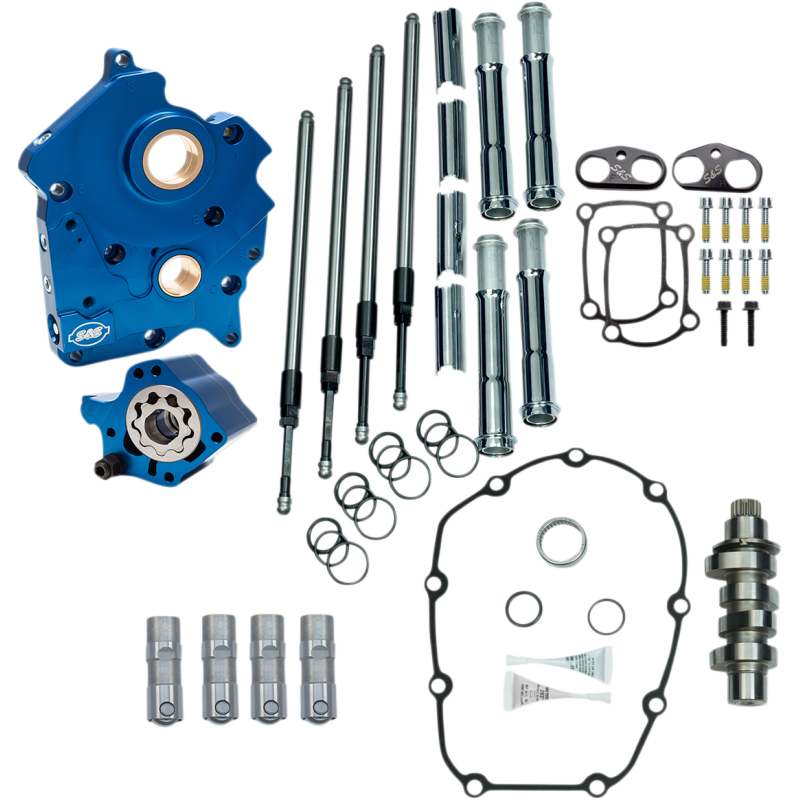
The one drawback: a cam swap means opening the engine, so labor is a real line item. Plan the tune at the same time.
Stage 3 and Stage 4: Big Bore Kits and Full Engine Builds
Big bore kits increase displacement with larger cylinders and matched pistons, the biggest single jump in output. A big bore cylinder kit such as the S&S Cycle 2,032 cc package for selected Milwaukee-Eight models pairs cast cylinders with matched forged pistons and includes head and base gaskets, ready for selected 2017 and later M8 models.
Stage 4 goes further with head work and a larger throttle body. If you would rather buy a complete package than piece a build together, an S&S 124 power package for oil-cooled M8 models bundles the matched components.
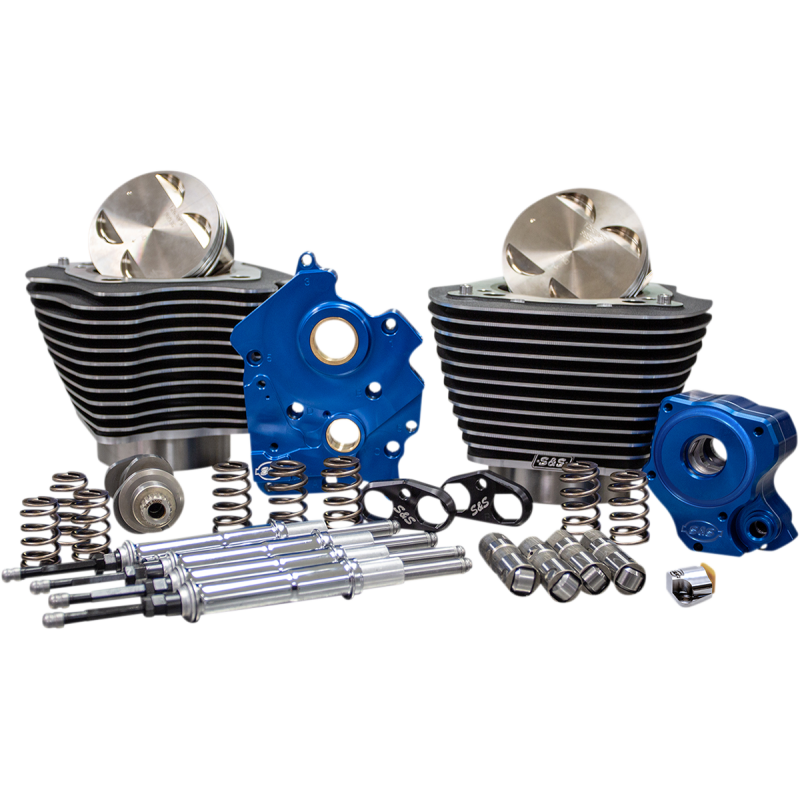
What most guides miss: at this level, supporting parts matter as much as the kit. Clutch capacity, oil cooling, and exhaust flow all become limiting factors.
Fuel Tuning and Dyno Tuning: Why the Tune Decides the Result
The tune converts parts into usable power, and it is where the most money is wasted. A flash tuner loads a calibration matched to your exact intake, exhaust, and cam combination; a dyno session refines it under load. Skip this and the engine runs on a map written for stock airflow, which is why a Stage 1 with no recalibration can feel flat and run lean in the midrange.
What the ECM Actually Adjusts
On late-model Harleys the ECM controls injector pulse width, ignition timing, and idle speed, reading O2 sensor feedback in closed-loop areas. Change airflow and the stock calibration's assumptions no longer match reality. A recalibration corrects fuel delivery across throttle and rpm, adjusts timing for the new airflow and fuel quality, and raises or removes rev and speed limiters where the build supports it. On throttle-by-wire models, the tune also reshapes throttle progressivity, which is why some riders notice sharper response before peak power changes.
Flash Tuner vs Dyno Session
A flash tuner writes a calibration to the ECU, usually over Bluetooth or cable, and backs up your factory tune first. The Dynojet Power Vision 4 fuel tuner flashes tunes over Bluetooth, stores your stock tune in the cloud, and logs real-time engine data. That logging matters: a third-gear pull shows whether the engine is knocking, fuel trims are maxed out, or intake air temperature is climbing.
A dyno session is a separate process from flash tuning, and it is a service this business has not verified it provides.
Where the Money Goes Wrong
Watch out: a pre-loaded tune written for a different intake and exhaust combination is not a match for your bike, and loading it can leave the engine lean at exactly the rpm where you ride hardest. The tune must match the parts, not just the stage number.
Fitment, Warranty, Emissions, and Reliability by Stage
Fitment is where projects stall, and the fix is checking three things before any part goes in the cart: engine family, displacement, and model year. The Twin Cam, Milwaukee-Eight (M8), and Revolution Max each have their own intake, exhaust, cam, and tuning ecosystems, and within the M8 the oil-cooled and liquid-cooled variants differ in ways that affect which cams, big bore kits, and oil cooling parts fit. A part listed for '2017 and later M8 touring' will not fit a 2016 Twin Cam, and a Softail fitment is not automatically a touring fitment even in the same model year.
A Practical Compatibility Check
Work through this before ordering:
- Confirm the engine family from your VIN or owner's manual, not from the model name alone.
- Confirm displacement, because a 107, 114, and 117 M8 take different big bore and cam combinations.
- Confirm cooling type on M8 models, since oil-cooled and liquid-cooled engines route cooling and exhaust differently.
- Confirm model year range on the listing, and treat 'fits select models' as a prompt to verify, not a guarantee.
- Confirm whether the part assumes a stock or already-modified intake and exhaust, because a cam ground for a stock exhaust can underperform with a full system.
As a Drag / Parts Canada dealer, we can help with the specific fitments you need.
Warranty
Warranty deserves a straight answer: aftermarket engine modifications can affect factory coverage, and the only reliable source is your dealer and the written terms. Warranty treatment of aftermarket parts varies, so confirm coverage with your dealer. Get the answer in writing before you buy, and keep receipts and the tuner's stock-tune backup.
Emissions and Road Legality
Emissions requirements vary by province and vehicle. Confirm what applies to your bike and province before buying, and keep the stock parts.
Reliability and Trade-offs by Stage
Reliability follows the same logic as power: each stage adds stress somewhere.
- Stage 1 adds intake and exhaust changes; a proper tune is needed to run them correctly.
- Stage 2 adds a camshaft, which changes valve timing and lift.
- Stage 3 and Stage 4 involve big bore cylinders and engine work, and supporting components should be planned alongside them.
Building Your Harley Davidson Performance Upgrades Plan
Start with your riding goal, then work backward. A commuter or two-up touring rider gets the most from a well-tuned Stage 1. A rider chasing a quicker Softail should plan Stage 1 and Stage 2 together.
- Confirm your exact model year, engine family, and cooling type
- Decide the riding goal before choosing parts
- Budget the tune into every stage, not as an afterthought
- Check warranty and emissions requirements before ordering
- Plan supporting parts for Stage 3 and above
Prices are in Canadian dollars, and shipping is free on orders over $200. Financing is available through Shop Pay, RBC PayPlan, or Sezzle, and as a Drag / Parts Canada dealer we can help source specific fitments.
Building a bike in stages means buying in stages, and the wrong first part can hold back everything after it.
Frequently Asked Questions
What is included in a Stage 1 Harley-Davidson upgrade?
Stage 1 is the intake, exhaust, and tune combination. It pairs a high-flow air cleaner with a less restrictive exhaust and an ECM recalibration. Intake and exhaust changes generally require ECM recalibration. In practice, a K&N Street Metal Intake System at $679.95, a FIREBRAND Grand Prix 2-1 exhaust at $1,134.95, and a Dynojet Power Vision 4 tuner at $978.95 form a complete Stage 1 path on compatible models.
Do Harley-Davidson performance upgrades require an ECU tune?
Yes, once you change airflow. Intake and exhaust upgrades generally require ECM recalibration, because the stock fuel map was written for the stock airbox and pipes. Skipping the tune leaves the engine running lean and gives up much of the gain you paid for. A flash tuner such as the Dynojet Power Vision 4 lets you load a matching tune, back up your factory map, and read or clear diagnostic codes. For cam or big bore work, a dyno tune is the safer route.
What is the difference between Stage 1, Stage 2, Stage 3, and Stage 4 upgrades?
Stage 1 covers intake, exhaust, and ECM recalibration. Stage 2 adds a camshaft, which is the next major gain once airflow and tuning are sorted. Stage 3 moves into engine work such as big bore cylinders and head work, and Stage 4 is a full engine build. Each stage assumes the one before it is done, so the supporting parts and tune stay matched.
How much horsepower can a Stage 1 upgrade add to a Harley-Davidson?
Gains vary by engine and configuration. The real gain depends on your engine, the exhaust you choose, and whether the tune is dyno-verified. Treat any specific number from a parts listing as a claim for that exact configuration, not a guarantee for your bike. A before-and-after dyno pull is the only way to know what your build actually made.
Can performance upgrades affect a Harley-Davidson warranty or emissions compliance?
They can. Aftermarket engine and exhaust parts may affect your factory coverage, and exhaust systems carry their own compliance status. Confirm exhaust compliance where you ride. Ask your dealer about coverage before installing engine parts, and check the emissions rules that apply in your province before changing the exhaust.
How do I choose performance upgrades for an older Harley-Davidson?
Start with fitment, then budget. Older big twin and Sportster platforms have different ECM systems and part numbers, so confirm your model year and engine displacement before ordering. Once fitment is confirmed, work in stage order: intake, exhaust, and tune first, then cam, then displacement.

Quote of the Day
Style is more than what we wear or how we decorate our spaces — it’s the freedom to choose what reflects who we are. Every design, every detail, is crafted with intention: to inspire joy, to add meaning, and to transform the everyday into something extraordinary. Because when comfort meets elegance, life itself feels more beautiful.
Brand Description
At our core, we believe that style should feel effortless yet meaningful. Each collection is carefully designed with attention to detail, blending modern aesthetics with everyday comfort. From timeless silhouettes to refined textures, our pieces are crafted to inspire confidence and elevate the way you live and dress. More than fashion, it’s a lifestyle made for you.